

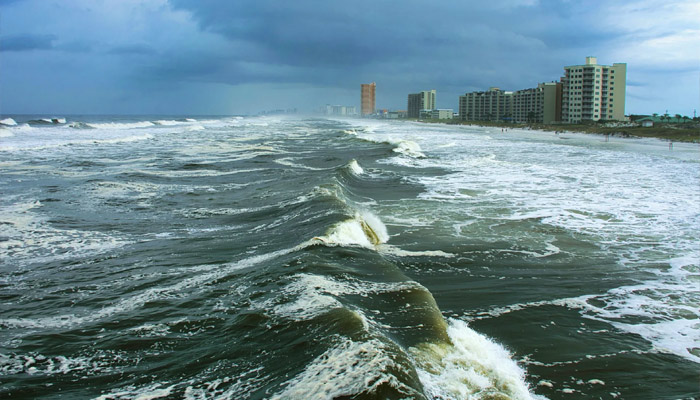
AI Revolutionizes Storm Surge Forecasting with Faster, More Accurate Predictions.
Walls of ocean water known as storm surges — pushed ashore by powerful storms — are becoming increasingly dangerous to coastal regions. Rising sea levels caused by climate change mean these surges start from a higher baseline (around 8 inches higher than in 1900 and projected to be 1–8 feet higher by 2100), worsening flooding and coastal damage. Hurricanes alone have caused more than $1.5 trillion in destruction across the U.S., with a significant portion attributed to surge-related flooding. Accurate forecasts are therefore critical to give residents time to evacuate and help authorities mount timely responses.
AI-Powered Surge Modeling
Traditionally, agencies such as the U.S. National Oceanic and Atmospheric Administration (NOAA) have relied on physics-based systems like ADCIRC, which simulate water movement using coastal grid maps. While highly detailed, these models can take hours to process even on supercomputers. Now, researchers are using artificial intelligence to accelerate the process.
Machine learning models are being trained on thousands of past storm simulations and real-world data to act as “surrogate” models. These AI systems analyze inputs such as wind speed, atmospheric pressure, and storm track to predict surge heights in a fraction of the time. In many cases, neural networks can match or even outperform traditional physics-based simulations — producing accurate forecasts in minutes rather than hours. To ensure reliability, researchers also train AI models on synthetic hurricane scenarios, helping them handle rare or extreme conditions.
Impact and Future Applications
The speed advantage could prove life-saving. AI-driven systems can rapidly produce street-level flood maps, showing which neighborhoods are most at risk. Some teams are even using AI to analyze post-storm imagery and estimate damage levels, filling crucial data gaps for disaster response.
Experts say that as AI models are integrated into operational forecasting systems, coastal communities could soon benefit from near-real-time surge alerts with far greater precision. With climate change driving stronger storms and rising seas, the ability to predict — and prepare for — surges faster than ever may be one of the most powerful tools in protecting lives and property.
Comments are closed.