

Delhi Air Pollution Protest Sparks Controversy Over Maoist Posters.
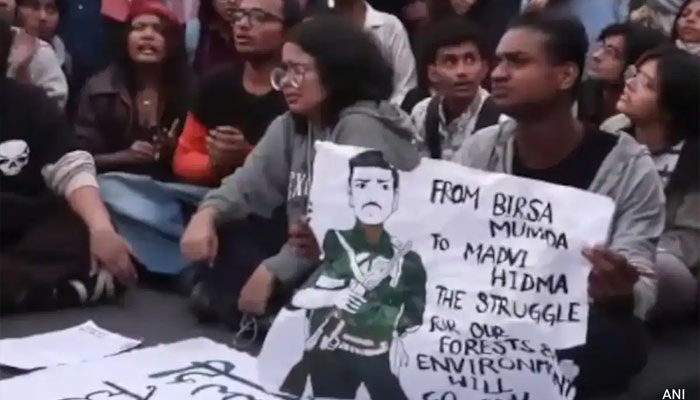
A protest against Delhi’s worsening air pollution at India Gate on Sunday evening took a controversial turn when demonstrators displayed posters of top Maoist commander Madvi Hidma, who was killed in a police encounter in Andhra Pradesh last week.
Tensions escalated as protesters reportedly tried to block traffic and allegedly used pepper spray against police officers attempting to disperse the crowd. Delhi Police have registered an FIR and launched a probe into how the Maoist posters appeared at the demonstration.
Viral footage shows a group of protesters sitting in the C-Hexagon area of India Gate, raising slogans against Delhi’s air pollution. Among them, one person can be seen holding a poster featuring a sketch of Madvi Hidma, Andhra Pradesh’s most-wanted Maoist commander, killed on November 18.
Security personnel arrived at the site and asked the demonstrators to leave, citing a Supreme Court order that designates Jantar Mantar as the official site for protests in Delhi. When the group refused, officers began dispersing them. So far, 15–20 people have been detained in connection with the protest and the alleged attack on personnel.
Delhi Development Minister Kapil Mishra praised the police action, calling it “a befitting response to such an ideology.” He tweeted, “Look at yesterday’s protest in Delhi: posters in hand under the guise of pollution, Red Salute slogans on their lips. The new face of jihadis and Naxalites posing as social activists.”
The protest was organised by the Delhi Coordination Committee for Clean Air, which has criticised the Delhi government’s so-called “cosmetic measures” such as water sprinklers and cloud seeding to tackle the rising pollution levels. The group called Delhi’s toxic air a “serious risk” to public health and said people are compelled to raise their voices for survival.
Highlighting the government’s failure, the activists accused the current development model—including mining projects, forest clearances, and rapid infrastructure expansion in fragile areas—of driving pollution, displacing communities, and worsening extreme weather. They also alleged that attempts to speak up are met with suppression, including detentions and restrictions.
This was the second major protest against Delhi’s air pollution this month. On November 8, activists, joined by leaders from AAP and Congress, marched to India Gate, demanding effective government action as the city’s Air Quality Index (AQI) crossed 400 in several areas.
On Monday, Delhi’s AQI remained dangerously high at 397, with 20 out of 39 monitoring stations recording severe pollution levels. Nearby Noida fared worse, with an AQI of 413, also in the severe range.
Comments are closed.