
Bangladesh Army Chief Opposed Yunus as Interim Leader, Ex-Adviser Claims

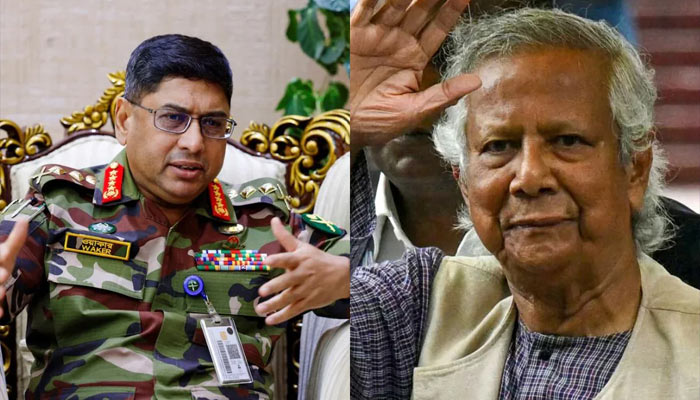
Former Bangladesh Law Adviser Claims Army Chief Initially Opposed Muhammad Yunus as Interim Head
Former Bangladesh Law Adviser Asif Nazrul has claimed that Army Chief General Waker-Uz-Zaman was initially reluctant to back Professor Muhammad Yunus as the head of Bangladesh’s interim government, raising concerns over the Nobel laureate’s legal cases before eventually agreeing to his appointment.
Nazrul, who served as the Adviser for Law, Justice and Parliamentary Affairs in the interim administration after the ouster of Sheikh Hasina in 2024, made the revelations during an interview with Bangladeshi newspaper Prothom Alo.
‘He Raised Two Objections’
Recounting a meeting at Army Headquarters, Nazrul said General Waker-Uz-Zaman sought his views on who should lead the interim administration after praising the student-led protest movement and supporting political reforms.
Nazrul said he informed the Army Chief that the student leadership had unanimously chosen Muhammad Yunus for the role and that he believed Yunus was the most suitable candidate.
According to Nazrul, the Army Chief expressed two reservations.
The first was Yunus’s conviction in a labour law case, while the second related to allegations of money laundering against him.
Nazrul Says He Convinced Army Chief
Nazrul claimed he argued that both the labour law conviction and the financial allegations were politically motivated and should not stand in the way of Yunus leading the interim government.
He said his explanation eventually persuaded General Waker-Uz-Zaman to accept the students’ recommendation and support Yunus’s appointment.
Background to the Legal Cases
Muhammad Yunus was convicted in January 2024 in a labour law case involving Grameen Telecom and sentenced to six months in prison for failing to establish a legally mandated workers’ welfare fund and provide statutory employee benefits. The conviction was later overturned after he assumed office as head of the interim government.
Separately, in June 2024, a Bangladeshi court indicted Yunus and 13 others in an embezzlement case involving more than $2 million. Yunus has consistently denied wrongdoing, with his supporters maintaining that the cases were politically motivated.
Rare Insight Into Political Transition
Nazrul was one of the key civilian figures associated with the 2024 anti-Sheikh Hasina movement and played an important role in coordinating with student leaders and sections of the military during Bangladesh’s political transition.
His remarks offer a rare account of the discussions that preceded the formation of the interim government and suggest that Muhammad Yunus’s appointment was not immediately endorsed by the military leadership before concerns over his legal cases were addressed.
Comments are closed.