
Centre Considers Setting Up Panel to Re-examine UGC Equity Regulations, Supreme Court Informed

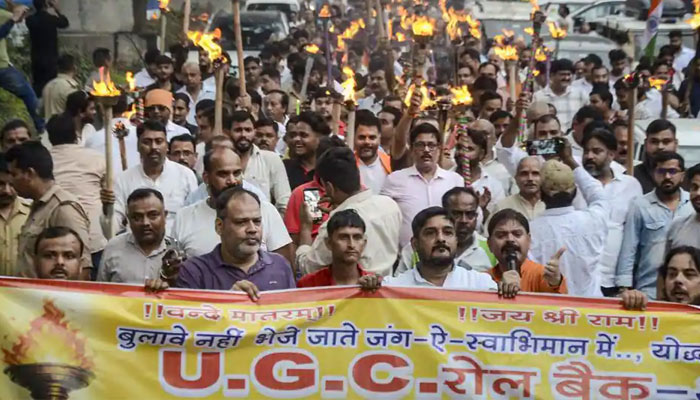
Centre May Form Committee to Reconsider UGC Equity Rules as Supreme Court Flags Concerns Over Fairness
The Union government is considering setting up a committee to review the University Grants Commission’s (UGC) 2026 equity regulations, the Centre informed the Supreme Court on Thursday. The development came after the top court urged the government to reconsider provisions of the controversial rules, which were stayed earlier this year following legal challenges over their scope and neutrality.
Solicitor General Tushar Mehta told a three-judge bench headed by Chief Justice of India Surya Kant that the government was contemplating the appointment of a committee to examine the regulations.
The bench, which also included Justices Joymalya Bagchi and V Mohana, suggested that the government revisit the rules to ensure that they safeguard the rights of all students without discrimination.
Questioning the need for an inclusive framework, the Chief Justice observed that the regulations should be designed to protect every student and ensure that future generations are not exposed to unequal treatment.
Controversy Over Definition of Caste-Based Discrimination
The UGC notified the Promotion of Equity in Higher Education Institutions Regulations, 2026, on January 13. However, the new framework soon triggered widespread objections from different sections of society, including general category groups and representatives of Dalit and OBC communities.
The principal point of contention is Regulation 3(1)(c), which defines caste-based discrimination as discrimination based on caste or tribe against members of Scheduled Castes, Scheduled Tribes and Other Backward Classes.
Petitioners challenging the provisions have argued that this definition does not explicitly extend specific protection against caste-based discrimination to students and faculty belonging to the general category.
However, the regulations contain a separate and broader definition of discrimination that covers unfair or differential treatment based on caste against any stakeholder in higher education institutions.
The disagreement over these provisions has raised questions about whether the regulatory framework provides equal and effective protection to everyone.
Supreme Court Questions Constitutional Validity of Provisions
The legal challenge has its roots in a 2019 petition filed by the mothers of Payal Tadvi and Rohith Vemula, who died by suicide in 2019 and 2016, respectively, following allegations of caste-based discrimination.
Their petition sought stronger safeguards and effective anti-discrimination mechanisms in universities and other higher education institutions.
On January 29, the Supreme Court stayed the implementation of the 2026 regulations and raised several questions concerning their constitutional validity and practical implications.
Among the key issues identified by the court were:
Definition of caste-based discrimination: Whether Regulation 3(1)(c) has a reasonable connection with the objectives of the regulations, particularly when no separate procedural mechanism has been established to address caste-based discrimination.
Protection of vulnerable communities: Whether the provisions adequately safeguard the interests of the most backward sections within SC, ST and OBC communities and address existing structural disadvantages.
Segregation in educational institutions: Whether provisions referring to segregation in hostels, classrooms, mentorship groups and other academic arrangements could create a separate-but-equal system, potentially violating constitutional guarantees of equality and fraternity.
Omission of ragging: Whether excluding ragging as a specific form of discrimination amounts to a regressive omission that could result in unequal access to justice for victims and raise concerns under Articles 14 and 21 of the Constitution.
Government Asked to Revisit Regulations
During Thursday’s hearing, the Supreme Court encouraged the Centre to examine the disputed provisions afresh rather than proceed with the existing framework without addressing the concerns raised.
The government’s indication that it may constitute a committee could pave the way for a broader review of the regulations and their impact on different student communities.
The central issue remains how to establish an effective mechanism against caste-based discrimination while ensuring that constitutional protections and institutional safeguards extend fairly to all students and stakeholders.
Any proposed changes will be significant for universities and higher education institutions across the country, which are awaiting clarity on the implementation of the UGC’s equity framework.
Comments are closed.