
Ceuta Migrant Crisis Explained: Why Thousands Crossed From Morocco Into Spain, Leaving 34 Dead

Ceuta Migrant Crisis Explained: Why Thousands Crossed Into Spain and Why Italy Wants Madrid Out of Schengen
A deadly migrant surge into Spain’s North African enclave of Ceuta has triggered one of Europe’s biggest political rows over migration in recent years, with Italy calling for Spain’s suspension from the passport-free Schengen Area and Finland backing the demand.
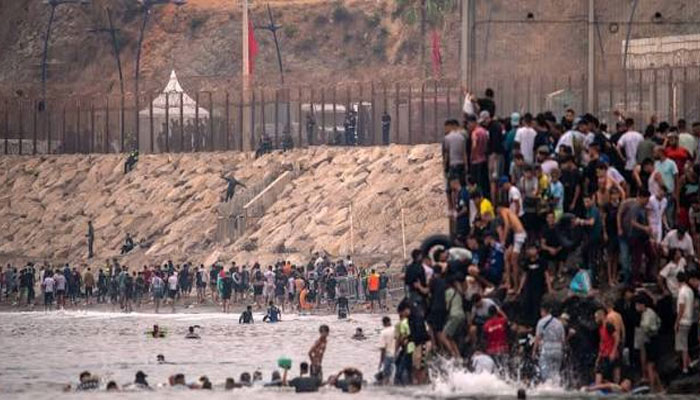
The crisis unfolded after around 60,000 migrants crossed from Morocco into Ceuta, overwhelming local authorities and sparking a humanitarian emergency. Spanish officials said at least 34 people died during the crossing—many by drowning while attempting to swim to the enclave and others in a stampede near the Tarajal border fence.
The events have reignited a long-running debate over Europe’s migration policy, border security and burden-sharing among EU member states.
What happened in Ceuta?
Ceuta, one of Spain’s two autonomous cities on Morocco’s Mediterranean coast, witnessed an unprecedented influx of migrants over a short period. Emergency shelters quickly ran out of space, forcing thousands—including women and unaccompanied minors—to sleep in parks, public squares and streets.
Spanish broadcaster RTVE aired footage showing burned vehicles on the Moroccan side of the border after clashes, while local officials described the situation as a “serious humanitarian crisis.” Rescue teams continued responding to new arrivals even as hospitals treated those injured during the crossing.
Why are migrants heading to Ceuta?
Ceuta has long served as one of the closest entry points into the European Union from Africa. Its geographical location makes it a key destination for migrants seeking employment, economic opportunities or refuge from conflict.
Many attempt the dangerous sea crossing by swimming several kilometres from the Moroccan town of Fnideq, while others depart from nearby Belyounech, where the distance is shorter.
Migrants say a lack of jobs, poverty and limited legal migration pathways continue to drive people towards increasingly risky routes into Europe.
What triggered the sudden surge?
Authorities have yet to identify a single cause behind the mass movement.
Officials in Ceuta pointed to a recent Spanish Supreme Court ruling preventing authorities from immediately returning migrants arriving by sea without legal procedures. However, activists questioned whether that judgment alone could have triggered such a large movement, arguing that most migrants were unlikely to have been aware of the ruling.
The unrest also spread beyond Ceuta. In Melilla, Spain’s other North African enclave, and nearby Moroccan border towns, clashes reportedly broke out between migrants and security forces, resulting in arrests, damaged vehicles and injuries to police personnel.
- Spain faces mounting pressure
- The scale of the influx has stretched Ceuta’s resources beyond capacity.
Regional leader Juan Jesús Vivas urged Madrid to declare a national emergency and deploy additional police and military personnel, warning that reception centres were full and hundreds of migrants remained without shelter.
Spain’s Interior Ministry said government agencies were coordinating relief efforts, while Prime Minister Pedro Sánchez was expected to visit Ceuta alongside Interior Minister Fernando Grande-Marlaska.
France also responded by tightening checks along its border with Spain and activating additional border security measures.
Why does Italy want Spain suspended from Schengen?
The humanitarian emergency quickly escalated into a diplomatic dispute after Italian Prime Minister Giorgia Meloni accused Spain of failing to protect the European Union’s external border.
Meloni said Italy was prepared to consider “exceptional measures,” including seeking Spain’s suspension from the Schengen Area, describing the scenes in Ceuta as “shocking.”
Italian Foreign Minister Antonio Tajani backed the proposal, arguing that uncontrolled migration posed a national security threat and criticising Spain’s immigration policies. Deputy Prime Minister Matteo Salvini went even further, calling for the suspension of the entire Schengen system until Europe’s external borders are secured.
Finland backs Italy
Italy’s stance received support from Finland, where Interior Minister Mari Rantanen argued that countries unable to protect the EU’s external frontier should not remain part of the Schengen Area.
Her comments reflect growing concern among several European governments over irregular migration and the effectiveness of the bloc’s border management system.
- Spain rejects the criticism
- Madrid has strongly pushed back against the accusations.
Foreign Minister José Luis Albares accused Italian leaders of politicising the humanitarian crisis and said Spain expected solidarity from its European partners rather than what he described as partisan attacks.
The dispute has highlighted widening divisions within the European Union over migration, border enforcement and responsibility-sharing.
What is the Schengen Area?
The Schengen Area enables passport-free travel across 29 European countries and is regarded as one of the EU’s cornerstone achievements.
While member states can temporarily restore border controls under exceptional circumstances, suspending a country from Schengen would be an unprecedented and politically contentious move requiring broad European consensus.
Why this crisis matters
Beyond the humanitarian toll, the Ceuta crisis has become a major political test for Europe. The deaths of at least 34 migrants, the unprecedented pressure on Spain’s border infrastructure and the sharp diplomatic confrontation between EU member states have once again exposed deep divisions over migration policy.
Whether Italy’s proposal gains wider backing remains uncertain, but the events in Ceuta have already reopened one of the European Union’s most contentious debates—how to balance humanitarian obligations with securing its external borders.
Comments are closed.