
Delhi Building Collapse: Owner, Wife Sent to 14-Day Judicial Custody; Son Gets 2-Day Police Remand

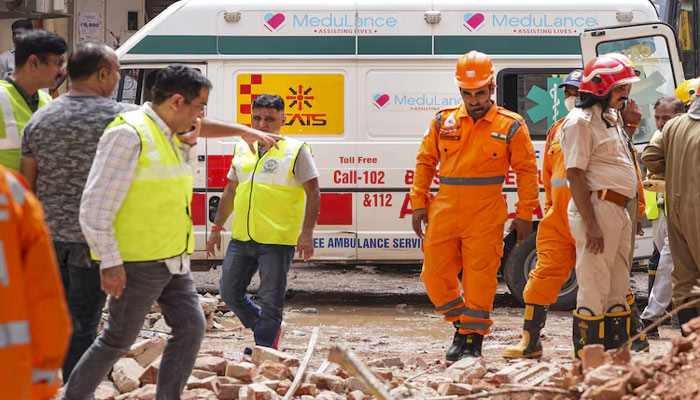
A 27-hour rescue operation at a five-storey boys’ paying guest accommodation in Delhi’s Satya Niketan ended on Monday with seven people dead and five injured, but the questions surrounding the collapse are only beginning.
The building, located near Delhi University’s South Campus, collapsed around 1.30 pm on Sunday while repair work was reportedly underway, trapping students and workers beneath the debris. The rescue operation continued through the night and was called off at around 5.10 pm on Monday.
The latest development came on Monday night when Hariram Gupta, his wife Urmila Gupta and their son Mahesh Gupta were produced before a Delhi court. Hariram and Urmila were sent to 14 days of judicial custody, while Mahesh was remanded to two days of police custody. The three were arrested in connection with the collapse.
Hariram Gupta, 81, a retired Indian Air Force sergeant, was arrested in Bhiwadi, Rajasthan, after allegedly going on the run following the incident. Urmila, 75, was the registered owner of the property, while the electricity connection was reportedly in Hariram’s name. Their son Mahesh, 52, allegedly managed the PG accommodation.
Investigators are now examining the role of the family, PG operators and the labour contractor. They are also looking into claims that the building had previously been sealed and scrutinising a rent agreement that allegedly sought to absolve the owner of responsibility.
The collapse has also triggered action against civic officials. Five MCD officials, including South Zone deputy commissioner Rakesh Kumar, have been suspended following the tragedy.
The Delhi High Court has ordered a high-level inquiry into the role of the MCD and other civic authorities. Observing that the government could not evade responsibility, the court described the incident as “most unfortunate” and said such tragedies raised concerns about inadequate safeguards and enforcement.
The inquiry could have wider implications for the regulation and inspection of buildings being used as paying guest accommodation, particularly in Delhi’s densely populated student hubs.
The Delhi government has also ordered action against buildings with unauthorised fifth floors. Chief Minister Rekha Gupta directed authorities to seal such structures and ordered inspections of PGs and other buildings in the surrounding areas.
The MCD has separately instructed field officials to intensify inspections of unsafe and dilapidated structures and verify whether construction conforms to sanctioned plans and safety norms. Junior engineers have been asked to conduct fresh surveys and identify buildings considered dangerous, structurally weak or beyond their intended service life.
Lieutenant Governor Taranjit Singh Sandhu has directed officials to conduct inspection drives in PG hubs, particularly in buildings suspected of violating height and floor restrictions. He has also asked the Chief Secretary to ensure structural audits of buildings in PG hubs are completed within a week.
Officials have additionally been asked to engage directly with students living in PG accommodation. Committees comprising district magistrates, deputy commissioners of police and MCD officials will reach out to students, record their grievances and prepare a database of those living in private accommodation.
The collapse has intensified demands from student organisations for safer and more affordable housing. AISA, ABVP and SFI held separate protests, while NSUI staged a demonstration in Satya Niketan. The protesters demanded accountability, action against those responsible and greater availability of safe accommodation.
The issue extends beyond a single building. Delhi’s major educational institutions attract students from across the country, while limited hostel capacity forces many to rely on privately operated PGs and rented accommodation. Students and their families often select accommodation based on location, rent and basic facilities, with little ability to independently assess a building’s structural safety.
The human cost of the collapse became evident at the AIIMS Trauma Centre, where relatives and friends gathered for information about those killed and injured.
The seven deceased were identified as Abhishek, 20, from Sonebhadra in Uttar Pradesh; Yuvraj Soni, 20, from Durg in Chhattisgarh; Pawan, 17, from Auraiya in Uttar Pradesh; Arpit Jahaj, 19, from Dewas in Madhya Pradesh; Akshat Singh Yadav, 18, from Katni in Madhya Pradesh; 75-year-old labourer Surinder Singh; and another person aged around 18 whose identity was yet to be established.
The injured were identified as Asgar Ali, 30; Neeraj Bawa, 19; Aditya Kumar, 19; Nitish Chib, 19; and Md Ayan, 18. AIIMS said three of the injured were in critical condition.
For the families, the tragedy has also highlighted the difficulty of assessing student accommodation. In one case, a first-year B.Com student had returned to Delhi on September 5. His mother said she had inspected several PGs before choosing the Satya Niketan property because it offered facilities such as air conditioning and a washing machine. She later identified her son’s body through distinctive marks.
Another survivor, second-year B.Com student Nitish Chib from Jammu, reportedly told his brother that he heard the sound of rushing water shortly before the collapse and ran towards a friend’s room. The building came down before they could make their way downstairs.
The accounts underline how quickly an ordinary day for students can turn into a disaster when structural safety measures fail.
The incident has also sparked a political confrontation between the BJP, AAP and Congress.
The AAP accused the BJP-led government of failing to focus adequately on the victims and questioned Union Home Minister Amit Shah’s activities on the day of the collapse. The BJP accused the AAP of politicising the tragedy and countered by raising the issue of former Delhi chief minister Arvind Kejriwal’s official residence, reviving the “Sheeshmahal” controversy.
Congress leader Rahul Gandhi also criticised the government, alleging that authorities often fail to prevent accidents and later shift responsibility to lower-level officials instead of fixing systemic shortcomings.
With arrests, an MCD inquiry, structural audits and inspections now underway, the Satya Niketan collapse has moved beyond a rescue operation. The larger question is whether Delhi’s authorities can ensure that buildings housing thousands of students are inspected, regulated and made safe before another tragedy occurs.
Comments are closed.