

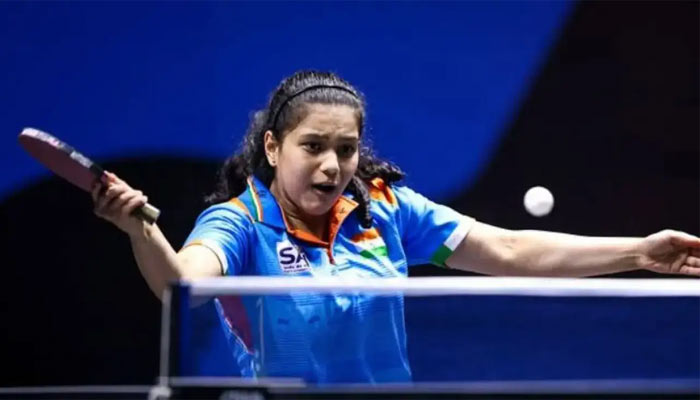
It’s easy to miss Diya Chitale in a crowd. Standing at 4 ft 11 inches tall, the diminutive 22-year-old moves with clinical economy — not a breath wasted, not a step more than necessary. You could walk past her without a second glance.
Diya Chitale: The Silent Storm of Indian Table Tennis
At 4 feet 11 inches, Diya Chitale is easy to miss in a crowd. She moves with quiet purpose—every breath measured, every step efficient. Blink, and you might walk past her without a second glance.
But inside the table tennis arena, she’s impossible to ignore.
Chitale becomes a storm in motion. Cold stare. Colder forehand. Jeer her, and she feeds off it. Rile her up, and she’ll break you down—point by point.
Just ask the Kolkata Thunderbolts. In a recent Ultimate Table Tennis (UTT) clash, Chitale trailed 3–7 against 19-year-old Ananya Chande. What followed was an eight-point masterclass. Silence swept the stadium. Delhi roared back. Game, Chitale.
Later, with a grin, she thanked the rival fans. “I think the drums really helped us until the end. Thank you for the drums,” she said in her post-match interview.
A Rising Force
At 22, Chitale is already among the vanguard of India’s next-gen table tennis stars. She and partner Manush Shah, currently ranked 11th in the world, recently won the WTT Contender Tunis 2025, toppling Japan’s Olympic medallist Miwa Harimoto and Sora Matsushima in a thriller.
Her rise comes at a pivotal moment. For the first time since the sport’s Olympic debut in 1988, India has qualified for the team events at Paris 2024. Eight athletes—its largest-ever table tennis contingent—will represent the country, led by flagbearer Sharath Kamal.
It’s a breakthrough moment for Indian table tennis, and Chitale wants to make it count.
Eyes on Olympic Glory
Chitale believes India’s best medal prospects lie in mixed doubles. With the LA 2028 Games set to introduce more medal events, the window of opportunity is wide open.
“I think in doubles, we have a big chance. The gap with top players used to be huge. Now, we’re closing it—match by match,” she says.
The Mumbai-born paddler is Dabang Delhi’s most expensive Indian player in UTT history, retained for ₹14.1 lakh. She’s repaid the faith handsomely, helping her side storm into the semifinals.
But beneath the success lies unrelenting discipline. Chitale’s day revolves around training, recovery, and nutrition. Even on Sundays, she carves out downtime with the same precision she applies to her backhand.
It’s no surprise, then, that her jacket reads “Virat.” Like Kohli, she’s intense, expressive, obsessive. She roars. She stares. She owns the table.
“I’m very self-motivated,” she says. “Even as a kid, my parents never had to push me to train. I just knew.”
The Coach Who Changed Everything
That drive found direction early, thanks to coach Sachin Shetty. Her table tennis journey began on family vacations, but turned serious after she won silver at the U12 Nationals.
“My coach Sachin Shetty—he’s the mastermind behind it all,” she says. His advice? If you want to win medals, not just play for India, you have to think beyond the borders—train abroad, compete more, and build from scratch.
Chitale listened. And evolved.
She’s now part of the government-backed TOPS developmental scheme, a support system that many Olympic hopefuls rely on. And she’s watched the sport change around her, in real time. “Earlier, no one knew players outside cricket. Now, they know Sindhu, Neeraj… It’s getting better. Slowly, but surely,” she says.
From Fan to Franchise Star
When UTT launched in 2017, Chitale was in the stands, cheering. In 2023, she got her first break with U Mumba. It was a disaster—she lost every match. But that season taught her more than any win could.
“Playing UTT is totally different. The pressure, the lights, the crowd—it’s something else,” she recalls.
Cut to 2025: Chitale is the league’s hottest Indian property and a genuine game-changer. She still hears the crowd. Still feeds off the pressure. But now, she owns it.
Learning to Let Go
As the 45-minute interview ends, she flashes a rare smile. It’s eaten into her precisely structured day—but she’s not fussed.
“I’ve learned not to hold things too tightly,” she says. “The more you chase something, the further it runs. Now I just put in the work. If it happens, great. If not, I try again.” For Diya Chitale, the spotlight is no longer a destination. It’s just the starting point.
Comments are closed.