
Elavenil Valarivan Stops Chasing the Medal, Then Clinches Two at Asian Games

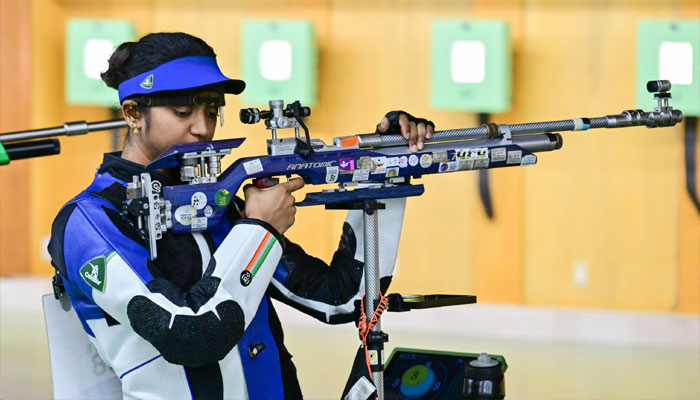
Elavenil Valarivan Turns Asian Games Disappointment Into a Day of Two Silvers.
Elavenil Valarivan came within a fraction of Asian Games gold on Sunday, but instead of dwelling on the narrow defeat, the Indian shooter chose to focus on what she could learn from it.
The 27-year-old led the women’s 10m air rifle final for much of the competition. After 20 shots, she had 211.1 points, holding a 0.3-point advantage over Japan’s Hinata Taichi. Two shots later, the lead had changed hands.
Hinata produced a 10.6 on the 23rd shot against Elavenil’s 10.4 and then finished with 10.2 compared to Elavenil’s 10.1. The Japanese shooter ended with 253.0, setting an Asian Games record, while Elavenil finished at 252.4 to take silver. Reigning Olympic champion Ban Hyo-jin claimed bronze with 230.4.
The result was painfully close, but Elavenil refused to blame pressure for the outcome.
“I would say no, not really. If pressure had to play a role, then it should have been from the beginning of the finals. For me, it was more about following my technique and following my process for every single shot,” she said.
Instead, she identified the final few shots as an opportunity to improve.
“There could be a lot of things that I could have done differently, but again, learning is the part that I’m looking more into right now,” she said.
Elavenil admitted that she could have made better decisions in the closing stages, particularly by slowing down and paying greater attention to her breathing.
“I could have taken better calls, but I didn’t, and hence the learning is what I’m taking from the last three shots. I could have been a little more patient in taking my shots and possibly worked a little more on my breathing,” she said.
A DAY TO REMEMBER
Sunday was still a landmark day in Elavenil’s career. Earlier, she had joined Sonam Uttam Maskar and Vidarsa K Vinod to win team silver, India’s first medal of the Asian Games.
India finished with 1898.0 points, 0.9 ahead of the hosts, while China took gold with a world-record performance.
Several hours later, Elavenil returned to the range and added an individual silver.
“I think today definitely is a very, very, very joyous day for me because this was my first Games medal,” she said.
“Although I’ve played in three Games prior to this — two Olympics and one Asian Games — I think this is my first medal. Of course, I’m going to cherish it to the core.”
For a shooter who had spent years carrying enormous expectations, the two medals represented more than just numbers on a scoreboard.
FROM TEENAGE PRODIGY TO EXPERIENCED SHOOTER
Elavenil’s reputation was established early. In March 2018, at just 18, she won gold at the Junior ISSF World Cup in Sydney. Her qualification score of 631.4 was a junior world record.
She had received her own rifle in 2016, joined the junior team the following year and trained at Gagan Narang’s academy under coach Neha Chavan.
Her early success brought expectations, but the senior Games did not immediately follow the same script.
At the 2018 Asian Games in Jakarta, she finished 14th and failed to reach the final. She missed the team for Hangzhou, while the Tokyo Olympics saw her enter as world No. 1 but finish 16th in qualification. At Paris, she again failed to make the final.
Yet international success continued. She won the Asian Championships in Shymkent last year with an Asian record of 253.6 and successfully defended the title this year.
The Asian Games medal remained the missing piece.
LEARNING TO ENJOY THE SPORT
Perhaps the biggest change has been Elavenil’s approach to competition.
Earlier, she said, success was primarily about making the team, winning competitions and collecting medals. Now, she has learned to appreciate the process itself.
“I think lately I’ve started to enjoy the sport. Initially it was more about me making it to the team, winning the competition, it was about winning it. But now it is more about enjoying it, enjoying just being a part of the team and representing the country,” she said.
She also described the difference between her mindset at the Paris Olympics and the one she brought to the Asian Games.
“Paris, it was more about me being the best of myself, winning the day and competing. But now it is more about just being happy that I get to play the sport, enjoying every single moment that I get on the lane, competing with my co-shooters,” she said.
That change does not mean she has stopped chasing victories. She still wanted the gold on Sunday. The difference is that missing it no longer wipes away everything else she accomplished.
WHY FINALS REQUIRE A DIFFERENT APPROACH
Elavenil believes qualification and finals demand completely different strategies.
“In qualification, we know that we have got 60 shots and 1 hour, 15 minutes in our hand. We can take our own time. But when it comes to the final, it is more about being on your toes and giving your best in those 50 seconds,” she explained.
Working with her coach and psychologist, she has been trying to adapt her pace and decision-making to the demands of a final.
“Generally, I’m a very fast athlete on the lane during my qualifications, but finals work on a completely different strategy because the time is less and you have to be your absolute best in that given time,” she said.
Her triggering — the moment she decides to fire — was one of the positives from Sunday’s competition.
“I had good triggering throughout my qualification and my finals. I was able to take the shots when I wanted to,” she said.
But she also identified it as an area that still needs work.
“There were times when I felt that possibly I could have delayed a bit and then taken the shot. So my judgement towards my triggering could have been a little bit better,” she added.
OVERCOMING SELF-DOUBT
The journey has included difficult periods. Elavenil acknowledged that there were times when she questioned herself, particularly when the results did not match the effort being put in.
“When we are working towards something and when we do not see the results, there’s, of course, going to be some level of self-doubt, some level of confusion, some level of frustration,” she said.
Her support team helped her through those phases.
“My coach, my psychologist, my strength and conditioning trainer, my nutritionist, my physio. They were all together working tirelessly for me. Their support throughout is what kept me going on my hard days,” she said.
Gagan Narang, whose academy played an important role in her early development, also spoke to her before Sunday’s final.
“He did tell me about me following his footsteps, which again, I’m very grateful to learn from him,” Elavenil said.
EIGHT YEARS OF EVOLUTION
Elavenil’s first Asian Games appearance came in 2018. Eight years later, she returned with two silver medals.
“Looking back, yes, 2018 was my first Asian Games. This, 2026 is my second. I have evolved as a person. I’ve learned so much,” she said.
The intervening years have included two Olympics, World Cups, World Championships and Asian Championships.
“And I think there’s a long way for me to go. I am still learning, still, there’s a lot of learning that’s coming up, and I am just glad that I’m getting this opportunity to learn every single day,” she said.
The teenager who once broke a junior world record was already an accomplished shooter. The 27-year-old who walked away with two medals on Sunday has developed beyond the technical side of the sport.
She has learned that a final is different from qualification, that patience can be as important as pulling the trigger and that a strong support system can help an athlete through periods of doubt.
Most importantly, she has discovered that enjoying the sport and wanting to win can exist together.
Asked what message she would give young shooters, Elavenil kept it simple.
“I think my message would be to believe in themselves. I kind of have been doing this, that is to believe in myself because when one starts to believe in themselves, I think there’s no stopping.”
The final 10.1 may have cost her individual gold, but Elavenil is choosing to treat it as a lesson rather than a lasting disappointment.
“Today’s learning is something that I would be taking today from here, but tomorrow, again, it’s a new day, it’s a new challenge for me,” she said.
Comments are closed.