
G20 Foreign Ministers Set to Conclude Atlanta Meeting Without Agreement on Major Global Issues

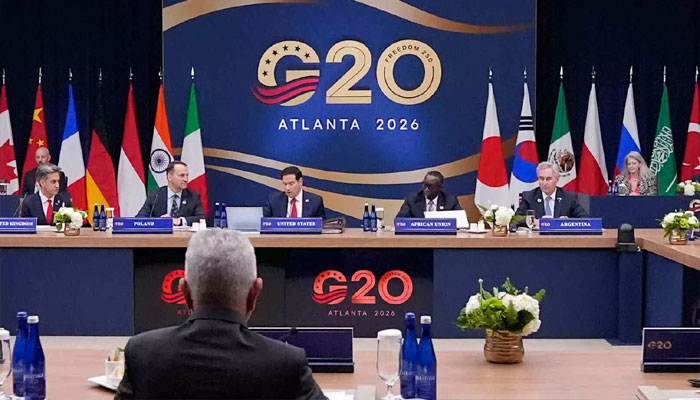
G20 Foreign Ministers Fail to Reach Consensus in Atlanta Amid Russia-Ukraine and Iran Conflicts
Foreign ministers representing the world’s 20 largest economies are set to conclude two days of discussions in Atlanta on Saturday without reaching a common position on several major international security issues. Differences over Russia’s war in Ukraine and other geopolitical disputes overshadowed the meeting from the outset.
Instead of issuing a joint communique, the G20 is expected to release a chairman’s statement summarising the discussions. US Secretary of State Marco Rubio will issue the statement at the conclusion of the meeting, according to diplomats familiar with the proceedings.
Rubio had opened the talks by calling for unity among member countries. However, tensions surfaced on Friday when he cancelled the traditional group photograph of foreign ministers. European representatives had objected to Russian Foreign Minister Sergey Lavrov’s participation and threatened to boycott or leave the photograph if he was included.
Polish Foreign Minister Radosław Sikorski, attending a G20 meeting as a guest for the first time, said the lack of agreement did not come as a surprise.
“We have wars going on, and we have participants in those wars around the table, so it’s very difficult to agree on a common line,” he told reporters.
Diplomats who participated in the closed-door discussions said members had nevertheless agreed to work through their differences and try to ensure the success of next month’s G20 leaders’ summit, which US President Donald Trump will host in Florida.
They added that the decision to issue a chairman’s statement rather than a joint declaration had been anticipated because of disagreements over several issues, including the Russia-Ukraine war, the US-Israeli conflict with Iran, American tariffs and China’s activities in the South China Sea.
These disputes have also contributed to fluctuations in global energy costs and uncertainty surrounding international trade.
Participants described the opening session as cordial but said Moscow remained firm on its position regarding Ukraine. Russia also opposes Poland’s membership in the G20. Disagreements have further emerged over the Trump administration’s decision not to invite South Africa, a G20 member, despite objections from other countries.
Russia’s participation sparks tensions with European countries
Russia’s presence at the Atlanta meeting had already raised concerns among several G20 members, particularly European countries, given Moscow’s continued military campaign in Ukraine.
The invitation came amid heightened Russian attacks on Ukrainian territory. Tensions between Washington and Kyiv had also increased after Trump moved to ease certain measures against Moscow and temporarily restricted logistical and intelligence assistance to Ukraine.
However, the US State Department announced on Friday that it had approved a proposed $2.1 billion sale of Patriot air defence interceptors to Ukraine.
Lavrov, meanwhile, said Russia would not accept a situation in which Ukraine posed a “military threat to legitimate security interests of the Russian Federation.”
Since Russia launched its full-scale invasion of Ukraine in February 2022, Lavrov has made relatively few visits to NATO member countries amid sweeping sanctions against Moscow.
It also remains uncertain whether Russian President Vladimir Putin will accept Trump’s invitation to attend the G20 leaders’ summit at the US president’s Miami golf club in December.
Iran conflict adds to geopolitical uncertainty
Freedom of navigation across major international waterways was among Washington’s key priorities for the Atlanta discussions. The talks covered the Strait of Hormuz, the Red Sea, the Black Sea and the South China Sea, with particular attention to tensions involving Iran, Russia, China and neighbouring countries.
The possibility of renewed US military action against Iran also remained a major concern during the meeting. The prospect has heightened anxiety across the Middle East, including in Saudi Arabia, which is a G20 member.
On the sidelines of the gathering, Rubio held discussions with Saudi Foreign Minister Prince Faisal bin Farhan and Turkish Foreign Minister Hakan Fidan. Turkey has played an important role in diplomatic efforts to mediate regional tensions.
The Associated Press has reported that US officials have advised several Middle Eastern countries and regional allies to prepare for the possibility of renewed military strikes against Iran after Tuesday’s midterm elections. Iran could retaliate against countries in the region if such action takes place.
The divisions at the Atlanta meeting underline the diplomatic challenges facing the G20 as its members attempt to address conflicts, energy security and global trade tensions ahead of the leaders’ summit in December.
Comments are closed.