
Poland Plunged into Midnight Political Chaos as Court Faces Police Guard, President Returns Amid Coup Allegations

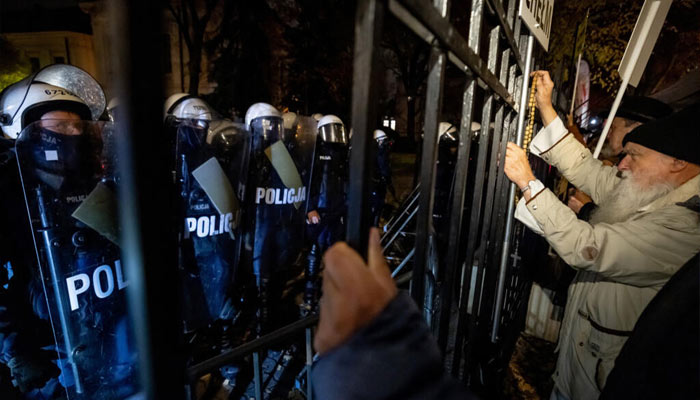
Poland Faces Constitutional Crisis as Police Guard Court, President Cuts Short Africa Visit
Poland has been plunged into a fresh political and judicial confrontation after riot police were deployed outside the Constitutional Tribunal, protesters challenged government action against senior judges and President Karol Nawrocki abruptly cut short his overseas visit to return to Warsaw.
The developments have intensified the ongoing battle between Prime Minister Donald Tusk’s pro-European government and the opposition Law and Justice (PiS) party over control of the country’s judicial institutions.
Tensions escalated when demonstrators breached the court’s perimeter fence and some protesters threw objects at police personnel. Riot police were subsequently deployed to restore order, while authorities confirmed that three people had been detained.
The crisis took another turn when Nawrocki, who is backed by PiS, announced that he was abandoning his trip to Senegal and returning to Poland. He had been travelling to attend the Summer Youth Olympic Games in Dakar.
“At a moment like this, the President must be in Poland. I am cutting short my flight to Senegal. I am returning,” Nawrocki wrote on X.
His chief of staff later confirmed that the president had entered the Constitutional Tribunal, adding another political dimension to the confrontation.
Government Targets Senior Constitutional Tribunal Officials
The immediate dispute centres on the position of Constitutional Tribunal President Bogdan Swieczkowski and the court’s Vice-President Bartlomiej Sochanski.
Justice Minister Waldemar Zurek sought to lift the immunity of both officials to enable criminal proceedings against them. The government alleges that they obstructed judges elected by the current parliamentary majority from participating in the tribunal’s proceedings.
The move has triggered strong opposition from PiS leaders, who accuse the Tusk administration of violating the country’s constitutional framework.
The Constitutional Tribunal has defended its leadership, maintaining that Swieczkowski and Sochanski remain its legally appointed senior officials. In a social media statement, the institution described the actions against them as a coup d’etat.
How Poland’s Judicial Dispute Began
The current confrontation is rooted in judicial reforms introduced by the PiS-led government, which governed Poland from 2015 to 2023.
Those changes attracted criticism from opposition groups and European institutions, which raised concerns about political influence over the judiciary and the independence of courts.
The European Court of Human Rights and the Court of Justice of the European Union subsequently questioned the legality of the appointment of three Constitutional Tribunal judges during the PiS government’s tenure, as their positions had already been filled by the previous parliament.
Donald Tusk came to power in 2023 promising to restore judicial independence and reverse the controversial changes.
However, his government has encountered resistance from President Nawrocki and his predecessor Andrzej Duda, both aligned with the opposition, who have used presidential veto powers to block proposed reforms.
Nawrocki has also declined to swear in five judges elected by parliament since March, questioning the process through which they were selected. Anna Korwin-Piotrowska has meanwhile been placed in temporary charge of the tribunal.
Suspension of Tribunal Chief Deepens Legal Uncertainty
News of Swieczkowski’s suspension appeared on the Constitutional Tribunal’s website on Friday evening. The website became inaccessible shortly afterwards, making it difficult to independently verify the official explanation for the decision.
Swieczkowski assumed the tribunal presidency during the PiS government’s tenure. Tusk has accused him of preventing judges elected by the present parliamentary majority from taking their positions.
Justice Minister Zurek’s attempt to initiate criminal proceedings against Swieczkowski and Sochanski has further complicated the situation.
However, the legal basis for the government’s action has also been questioned. Lawyer Marcin Matczak, who has previously criticised Swieczkowski’s leadership, said the suspension lacked a legal foundation.
The Venice Commission, an advisory body of the Council of Europe on constitutional matters, had earlier urged Nawrocki to swear in the five judges elected by parliament so they could assume their positions.
Tusk Defends Government Action, PiS Demands Resistance
Prime Minister Donald Tusk has defended his administration’s efforts, arguing that restoring the rule of law requires decisive steps despite the legal and political difficulties.
“Restoring the rule of law is our duty. After years of Law and Justice’s lawlessness, this is a difficult, sometimes painful process that requires decisive action. There is no other way,” Tusk wrote on X.
PiS leaders have strongly rejected the government’s position. Former Justice Minister Zbigniew Ziobro described the suspension of Swieczkowski as a criminal attack on Poland’s constitutional order and urged supporters to resist the government’s actions.
The confrontation has also raised concerns among legal experts about the use of police forces inside or around judicial institutions and the extent of the Justice Minister’s authority.
With parliamentary elections scheduled for next year, the dispute has become an important political issue. Some government supporters have questioned the pace of Tusk’s efforts to reverse the PiS-era judicial changes, while others have raised concerns about the legal methods being used by his administration.
The latest developments have once again exposed Poland’s deep divisions over judicial independence, constitutional authority and the balance of power between the government, parliament and presidency.
Comments are closed.