
Germany’s Far-Right AfD Makes Historic Regional Election Gain, Misses Majority

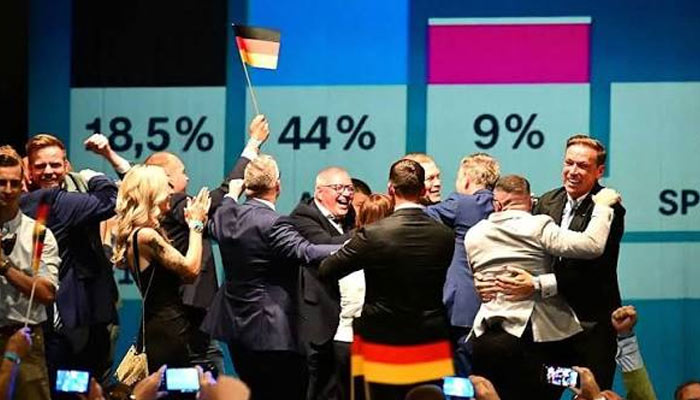
Germany’s far-right Alternative for Germany (AfD) has delivered a historic electoral upset in the eastern state of Saxony-Anhalt, emerging as the strongest party in the regional election but falling just short of the majority needed to govern alone.
The AfD was projected to secure around 44% of the vote, more than twice its 23.7% share in the 2021 election. Chancellor Friedrich Merz’s Christian Democratic Union (CDU), which has governed the state since 2002, was trailing at roughly 18%, according to Reuters.
The result gives the AfD 39 seats in the 83-member state parliament — three short of the 42 needed for an outright majority. Its route to government remains uncertain as the party has ruled out coalition arrangements, while Germany’s mainstream parties continue to maintain a political firewall against working with the far right.
AfD lead candidate Ulrich Siegmund, 35, described the result as a historic breakthrough.
“We have made history in this state,” Siegmund told supporters as the projections were announced, arguing that voters had delivered a clear message that “things cannot carry on like this”.
AfD co-leader Alice Weidel called the result a “clear government mandate”. Siegmund, meanwhile, indicated that the party could approach political forces willing to support change.
However, the AfD has so far shown little appetite for heading a minority administration. Siegmund suggested that a fresh election could be held if no government can be formed, predicting that the AfD could potentially increase its support to 50% or even 55%, the BBC reported.
AfD’S CONTROVERSIAL POLITICS
Immigration and domestic security were among the central themes of the AfD campaign. The party backs what it calls “remigration”, a policy its critics associate with mass deportations. The AfD maintains that the term refers primarily to the deportation of criminals and people residing in Germany illegally.
The party has also faced repeated criticism over its positions on immigration, the European Union and Germany’s Nazi past.
In Saxony-Anhalt, the AfD has attacked the Bauhaus school in Dessau, describing it as a “dead-end of modernism”. Critics have accused the party of using rhetoric reminiscent of Germany’s far-right past.
Björn Höcke, the AfD leader in neighbouring Thuringia, has also been at the centre of controversy over his comments on Germany’s Nazi history. In 2017, he described Berlin’s Holocaust memorial as a “monument of shame” and called for the country to move away from what he termed its culture of remembrance. A German court ruled in 2019 that describing Höcke as a “fascist” was not defamatory.
CDU SUFFERS MAJOR SETBACK
The result represents a major blow for Merz’s CDU, which has dominated Saxony-Anhalt politics for more than two decades. Its projected vote share has fallen by more than half compared with the previous election.
CDU state leader Sven Schulze acknowledged the defeat, describing the campaign as exceptionally difficult and intensive. The party reiterated that it would not enter into cooperation with the AfD.
CDU general secretary Franziska Hoppermann also described the result as a broader defeat for the party and a setback for those who have governed the state since the end of communist rule.
The outcome could add pressure on Merz, whose standing among voters in the state has been weak. A recent poll found that only 9% of respondents were satisfied with his political performance. Siegmund even credited Merz with helping the AfD during the campaign.
The AfD’s biggest obstacle to power remains the refusal of mainstream parties to cooperate with it. This strategy, known in Germany as the Brandmauer, or firewall, is designed to prevent the far right from entering government.
The AfD’s organisation in Saxony-Anhalt has been classified as “right-wing extremist” by Germany’s domestic intelligence agency, a designation rejected by Siegmund.
BSW ENTRY COMPLICATES AF D’S PATH
The left-wing Die Linke was projected to finish third with around 9.3%, followed by the Greens on 8.7% and the Social Democrats on 8.4%.
The Sahra Wagenknecht-led BSW also appeared to have crossed the 5% threshold required to enter the state parliament.
Its entry could prove significant because it makes an AfD majority more difficult. The BSW has demonstrated a willingness to cooperate with the AfD on selected issues, including energy-price reforms, although it has not committed to joining an AfD-led government.
WHY THE ELECTION MATTERS
The vote was closely watched across Germany because no far-right party has governed a German state since the end of World War II.
An AfD-led state government would give the party direct influence over areas such as policing, education and culture, significantly expanding its political reach.
Turnout was unusually high at around 76.5%-76.7%, with approximately 1.7 million people eligible to vote in the state, whose population is about 2.1 million.
The AfD’s strongest support continues to come from eastern Germany. It also emerged as the largest party in Thuringia’s 2024 state election but failed to secure enough seats to form a government.
At the national level, the AfD has also been leading opinion polls ahead of Merz’s conservatives and the Social Democrats, underlining the growing influence of the far right in German politics.
GLOBAL REACTION TO AFD SURGE
The election result drew reactions well beyond Germany.
US President Donald Trump shared a screenshot of the German election projections on Truth Social, while Russian presidential envoy Kirill Dmitriev praised the AfD’s performance.
Polish Prime Minister Donald Tusk took a sharply critical stance, saying that “in Poland only idiots and traitors can rejoice at the triumph of the AfD”.
The result has also alarmed the party’s political opponents and Jewish community leaders.
Charlotte Knobloch, a Holocaust survivor and veteran leader of Munich and Bavaria’s Jewish community, said the result frightened her.
“On days like this I find it hard to recognise my homeland any more,” the 93-year-old said, urging mainstream political parties not to stand by and allow what she described as the country’s “decline”.
Comments are closed.