
India Win Men’s Asian Games Hockey Gold Again — But Was This Title Really Special?

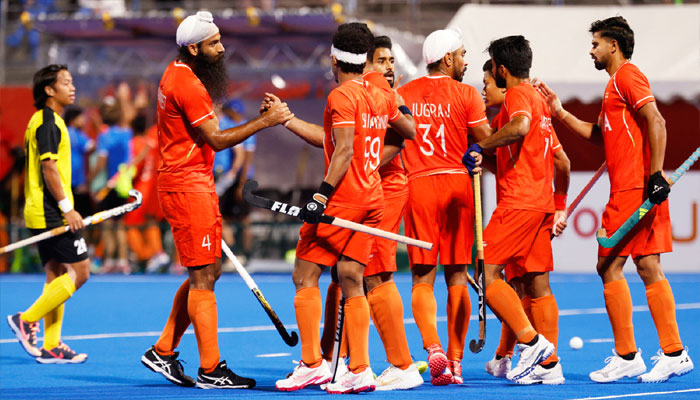
India’s Men’s Hockey Gold Was Historic. So Why Did It Feel Almost Routine?
Indian hockey produced one of its biggest moments in Nagoya, with both the men’s and women’s teams winning Asian Games gold after unbeaten campaigns.
For the women, the triumph ended a 44-year wait for the continental title. It was their first Asian Games gold since 1982 and a victory that carried enormous emotional weight.
For the men, it was another gold medal — a successful defence of their title and a direct ticket to the Los Angeles Olympics.
Yet the two victories generated very different reactions.
The women’s triumph was celebrated as a breakthrough. The men’s gold, despite being equally significant in terms of medals and Olympic qualification, almost felt like an expected outcome.
That contrast raises an intriguing question: why did India’s men’s hockey gold feel less special?
EXPECTATIONS HAVE CHANGED
India entered the men’s hockey competition in Nagoya as overwhelming favourites.
Anything other than gold would have been considered a major disappointment. Harmanpreet Singh and his teammates were not simply expected to compete for the title — they were expected to win it.
Former India goalkeeper PR Sreejesh captured that mindset perfectly after the final.
“Nothing special. We won. We were supposed to win. We are the Asian Champions. And yes, WE ARE GOING TO LA!” he posted.
It was clearly a celebration of the achievement, but the wording also reflected how much expectations around Indian men’s hockey have changed.
Winning Asia is no longer viewed as an extraordinary accomplishment for this team. It has become the minimum requirement.
ASIAN HOCKEY NO LONGER PROVIDES THE SAME TEST
One major reason is the current state of men’s hockey in Asia.
India’s dominance has coincided with a decline among several of their traditional continental rivals. The recent World Cup highlighted the gap.
India finished eighth, while Pakistan were 11th, Japan 14th and Malaysia 15th. South Korea, four-time Asian Games champions, failed to qualify.
That meant India arrived in Nagoya without many genuinely threatening opponents.
The numbers tell the story.
India won three group-stage matches by margins of 10 goals or more. They scored eight against Korea, while Japan managed to restrict them to two.
The semi-final against Pakistan provided the real test, but even that contest eventually swung India’s way. The final against Malaysia ended 5-1.
The gold was thoroughly deserved. But the path to it offered little drama.
And when dominance becomes predictable, even a major achievement can begin to feel ordinary.
THE WORLD CUP WARNING SIGNS REMAIN
The Asian Games also did not completely erase the concerns that emerged at the World Cup.
India looked comfortable against most opponents, but the semi-final against Pakistan exposed familiar weaknesses.
India raced into a 3-0 lead before losing control of the contest. Pakistan fought back to level the score at 3-3, forcing India to rely on a late penalty stroke to secure victory.
The problems were familiar: defensive lapses, poor discipline and unnecessary fouls.
Former goalkeeper Romeo James pointed to the same concern, arguing that the defensive improvements India had spoken about were not consistently visible against Pakistan.
Those issues did not suddenly appear in Nagoya. They have been present throughout the year, including during India’s disappointing Pro League campaign.
The World Cup magnified them. The Asian Games merely pushed them into the background because India were far stronger than most of their opponents.
THE WOMEN SHOWED WHAT A RESET CAN DO
Perhaps the biggest lesson from Nagoya came from India’s women’s team.
Their gold medal was not simply the result of individual brilliance. There was a noticeable sense of freshness, organisation and tactical clarity within the squad.
Coach Sjoerd Marijne deserves credit for building that environment and introducing a more modern approach to the team’s preparation.
Fitness and mental-conditioning specialists were brought in, while specialist goalkeeping coaches worked with Savita Punia and Bichu Devi.
The result was a team that appeared physically prepared, mentally composed and tactically clear.
More importantly, every player appeared to understand her role.
That freshness was reminiscent of what happened with the men’s team at the 2022 Asian Games in Hangzhou.
After the disappointment of the 2018 Asian Games and the disastrous 2018 World Cup, India underwent a transformation under Craig Fulton.
The team played with a clear tactical identity and remarkable consistency. Every match was won by at least two goals, while Pakistan were dismantled 10-2.
There was a feeling that Indian hockey had entered a new phase.
In Nagoya, that sense of renewal was harder to detect.
DOES FULTON NEED A RESET?
Fulton’s philosophy of building from the back helped transform the men’s team, but the World Cup exposed questions about whether the approach now needs refinement.
The Asian Games success does not eliminate those concerns.
India’s dominance against Asian opposition can hide weaknesses that are likely to be exposed against the world’s strongest teams.
The next Olympic cycle therefore offers an opportunity to reassess tactics, personnel and preparation rather than simply continuing with the same formula.
THE FEDERATION’S FIGHT IS ANOTHER CONCERN
The issues surrounding Indian hockey are not confined to the pitch.
The continuing power struggle within Hockey India, involving President Dilip Tirkey and Secretary General Bhola Nath Singh, has created considerable noise around the sport.
The players managed to remain focused in Nagoya, but prolonged institutional instability can eventually affect the wider system.
Romeo James, who recently joined former hockey players in a protest in Delhi, warned that the conflict could eventually filter down to the team.
With Hockey India elections scheduled for November, the internal battle could intensify further.
For a team beginning an Olympic cycle, stability off the field is just as important as preparation on it.
INDIA NEEDS NEW FACES
The biggest challenge now is to ensure that the Nagoya gold does not create complacency.
Several experienced players are deep into their international careers. Veterans such as Manpreet Singh, Mandeep Singh and Amit Rohidas continue to contribute, but the Olympic cycle also needs to be used to integrate younger players.
James believes India must begin bringing in fresh blood.
The objective should not be to discard experienced players simply for the sake of change. Instead, younger players need regular exposure alongside established names so that the transition is gradual rather than forced.
BETTER OPPOSITION IS ESSENTIAL
India also need to regularly play teams capable of exposing their weaknesses.
The World Cup showed the danger of dominating weaker opposition without being sufficiently tested by higher-ranked sides. India failed to beat a team ranked above them in that tournament.
Another Asian competition will not necessarily provide the level of preparation required for Los Angeles.
As James suggested, India should look at playing more matches against top European and other leading hockey nations, either by travelling abroad or bringing those teams to India.
Only sustained exposure to stronger opposition can reveal where the team genuinely stands.
GOLD IS STILL GOLD
None of this takes away from India’s achievement in Nagoya.
The team remained unbeaten, won the Asian Games title and secured Olympic qualification. Those are significant accomplishments.
As James put it, “A winner is a winner.”
And that is perhaps the fairest way to view the campaign.
The men’s gold should not be judged as less valuable simply because India were expected to win it. Nor should the lack of drama surrounding the campaign diminish what the players achieved.
But the muted reaction may also serve as a warning.
For India, winning Asia is no longer the ultimate goal. It is a checkpoint.
The real test will come in Los Angeles.
Before then, India need to sharpen their defence, introduce fresh talent, seek tougher opposition and perhaps rethink aspects of their tactical approach.
The Asian Games showed that India remain the dominant force in Asia.
The next Olympic cycle will determine whether they can once again become a genuinely formidable force beyond the continent.
Because when a gold medal starts to feel routine, the challenge is no longer simply to win it.
The challenge is to become good enough that the rest of the world starts taking notice.
Comments are closed.