

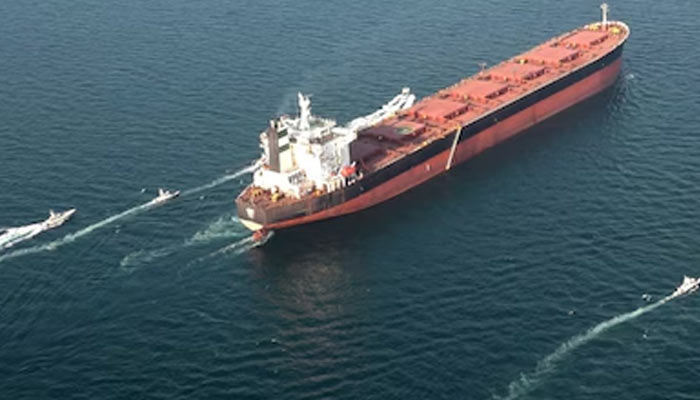
Iran is proposing a new revenue-sharing mechanism for the Strait of Hormuz that would see Gulf nations jointly levy service fees on ships using .
The strategic waterway, with Tehran estimating the arrangement could generate as much as $40 billion annually.
According to The Wall Street Journal, Iran has discussed the proposal with Gulf countries as well as China, arguing that ships should pay for maritime security, safety and environmental services provided in and around the strait.
Tehran is seeking to model the system on Turkey’s administration of the Dardanelles Strait, where vessels pay a transit charge—known as the gold franc—for services including lighthouses, sanitation and maritime safety.
“Everyone needs to know that management of the strait will never return to the way it was before,” Iran’s chief negotiator, Mohammad Bagher Ghalibaf, said during a visit to Oman, where he discussed the proposal with officials.
The idea has been firmly rejected by the United States.
President Donald Trump said Iran had assured Washington it would not impose tolls or additional charges on vessels transiting the Strait of Hormuz.
“There are no tolls, no insurance costs & no other charges of any kind being sought or received by Iran on ships traveling the Strait of Hormuz,” Trump wrote on social media.
US Secretary of State Marco Rubio also dismissed the proposal, saying no country has the right to charge ships for using an international waterway.
“The reality is that no country on earth has the right to charge for the use of international waterways, and that will never be an acceptable condition of any deal,” Rubio said during a visit to the Gulf.
According to The Wall Street Journal, Iranian officials have also floated the idea with China and Egypt, while indicating that the United States could join the payment mechanism in the future if it chose to do so.
Iran’s proposal draws inspiration from the Dardanelles, the narrow strait linking the Black Sea with the Mediterranean. Under the 1936 Montreux Convention, Turkey is permitted to collect transit charges from ships for services such as navigation aids, sanitation and maritime safety. For the tariff year beginning July 1, 2026, the charge has been set at $6.70 per tonne.
Legal experts, however, argue that the comparison has significant limitations.
James Kraska, a maritime law professor at the US Naval War College, told The Wall Street Journal that Iran cannot simply replicate Turkey’s model because navigation through the Strait of Hormuz is governed by separate international and regional agreements.
“Iran has signed international and regional agreements that ban it from imposing unilateral payments on passing ships,” Kraska said.
The report added that any proposal allowing Iran to collect service charges would require approval from the International Maritime Organization (IMO), the UN agency overseeing global shipping. Such a framework would need the backing of the IMO’s 176 member states, making unilateral implementation by Tehran legally and diplomatically difficult.
Comments are closed.