

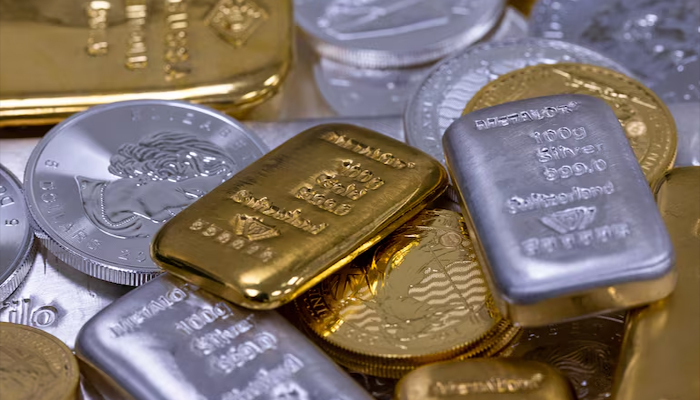
Silver prices crashed to the 15% lower circuit on Friday, while gold tumbled sharply amid aggressive profit-booking, triggering extreme volatility across.
The bullion complex on the Multi Commodity Exchange of India (MCX). Silver futures plunged the maximum permissible 15% in intraday trade, while gold contracts slid nearly 10%, marking one of the steepest single-session declines in recent years. The sell-off followed an extended rally in precious metals, prompting traders to lock in gains as global cues turned less supportive.
Market data showed intense selling pressure across bullion and base metals, with MCX iCOMDEX indices reflecting broad-based weakness. Gold and silver witnessed sharp intraday swings before recovering marginally, highlighting elevated volatility in the commodities market.
The correction came a day after prices had surged to record highs, with gold crossing Rs 1.75 lakh per 10 grams and silver jumping past Rs 4 lakh per kg on Thursday.
MCX price update
As of 4:45 pm, silver had recovered from the day’s lows and was trading at Rs 3,58,900 per kg on the MCX, still down around 10% from the previous close. Gold also pared losses to trade at Rs 1,63,550 per 10 grams, lower by 3.46%.
Why are bullion prices falling?
Analysts said the sharp correction reflects stretched valuations after the recent surge in precious metals, combined with profit-taking and a shift in global risk sentiment. Markets are also closely tracking US monetary policy signals, political developments and movements in the dollar for further direction.
Kaynat Chainwala, assistant vice-president (commodity research) at Kotak Securities, said bullion prices reversed sharply due to global profit-taking and a broader risk-off environment.
“Bullion prices saw a sharp reversal, with gold sliding towards $5,100 per ounce and silver towards $108 per ounce on profit-taking, compounded by a broader sell-off across global markets,” she said.
Chainwala noted that while the previous session was extremely volatile — with both metals rebounding from intraday lows — selling pressure resurfaced on fresh concerns.
“Gold slipped below $5,100 per ounce and silver dipped under $105 per ounce amid continued profit-taking and reports of President Donald Trump’s imminent nomination of inflation hawk Kevin Warsh as the next Federal Reserve chair,” she added.
Easing political uncertainty in the US also weighed on safe-haven demand. “A tentative deal between Trump and Senate Democrats to avoid a US government shutdown further pressured haven assets,” Chainwala said.
US President Donald Trump has said he plans to announce his nominee to replace Federal Reserve Chair Jerome Powell, intensifying speculation over a potentially more hawkish policy stance after Powell steps aside in May.
“A less dovish Fed chair pick, a rebound in the dollar and overbought conditions have contributed to the decline in gold prices,” Reuters quoted KCM Chief Trade Analyst Tim Waterer as saying.
Similarly, Matt Simpson, senior analyst at StoneX, said rumours of Kevin Warsh replacing Powell weighed on gold during Asian trade.
Manav Modi, commodities analyst at Motilal Oswal Financial Services, said gold and silver hit lower circuit levels across all MCX formats, including mega and mini contracts.
“This is strong profit-booking from higher levels, and ETF prices are down by a much larger percentage than futures,” he said.
What should investors do?
Nikunj Saraf, CEO of Choice Wealth, said the sharp fall in gold and silver ETFs reflects classic profit-taking after Thursday’s record highs on the MCX.
“A hawkish Fed chair pick under President Trump sparked fears of tighter policy, strengthening the US dollar and pushing overbought metals sharply lower,” he said, adding that spot gold fell to around $5,183 per ounce, while silver dropped to $109.55 per ounce.
Indian ETFs mirrored the move, with products such as Nippon India Silver ETF falling nearly 14%.
“For investors, this correction tests conviction. Diversification, avoiding panic selling and watching for potential rebounds driven by central bank demand remain key. Long-term investors may choose to hold through the volatility,” Saraf said.
Comments are closed.