
Nepal Flood Toll Nears 500 as Search Intensifies for 1,498 Missing Amid Fresh Flood Threat

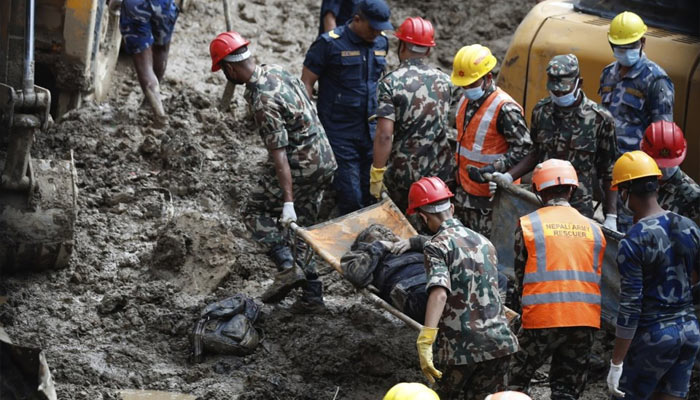
The Nepal-Tibet flash flood disaster has killed at least 469 people, with 1,468 still missing on both sides of the border as rescue teams race to reach isolated areas and recover survivors. India is also working to trace 290 nationals who remain uncontactable.
The disaster was triggered by an ice-rock avalanche following a glacial collapse near the Nepal-Tibet border. The resulting torrent of water, mud and debris swept through central Nepal, destroying homes, roads, bridges and hydropower infrastructure.
Rasuwa and Nuwakot were among the worst-hit areas, with entire settlements buried under mud and wreckage. The floods also caused extensive damage along the Bhote Koshi and Trishuli river systems, leaving several communities cut off from the outside world.
469 dead, 1,468 still missing
Nepal Police said 796 people, including 50 foreign nationals, were rescued by helicopter, while another 796 were evacuated by land.
Nepal authorities have reported 910 people missing, while officials in Tibet have reported another 558 missing, taking the combined number of unaccounted people to 1,468.
Rescue teams involving the Nepal Army, Nepal Police and Armed Police Force are searching riverbanks, downstream settlements and isolated areas using helicopters, drones and ground teams.
At least 44 Nepal Army personnel, 28 Nepal Police personnel and 13 Armed Police Force personnel are among those reported missing. Around 160 people working at hydropower projects and customs offices are also unaccounted for.
Chitwan has reported the highest number of recovered bodies, with 137 found in the district. Bodies have also been recovered from Rasuwa, Nuwakot, Dhading, Gorkha, Tanahun and Nawalparasi.
India searches for 290 missing nationals
India has launched a major effort to trace 290 nationals in Nepal who remain uncontactable.
External Affairs Minister S Jaishankar said the government was coordinating with Nepal, state governments, tour operators and other authorities to determine their whereabouts and arrange assistance.
Prime Minister Narendra Modi also spoke with Nepal Prime Minister Balendra Shah and assured him of India’s humanitarian support.
India has so far rescued 84 nationals, including 63 workers from the Trishuli-I hydropower project and 21 people from Tamil Nadu.
Around 200 Indian nationals on the Tibet side have also sought help with evacuation.
The Ministry of External Affairs has established a 24-hour control room to assist with tracing and evacuation efforts.
Foreign tourists rescued
Nepalese authorities rescued 27 foreign tourists stranded in Rasuwa, including 11 Indians.
The group also included four South Koreans, two Italians and two US citizens. The tourists were airlifted to Kathmandu by the Nepal Army.
Many of the affected Indian tourists were travelling towards Kailash Mansarovar in Tibet or Gosainkunda in Nepal.
Road transport has also been disrupted, with Delhi-Kathmandu bus services suspended as a precaution.
New barrier lake raises fresh flood fears
Even as rescue operations continue, authorities are facing the possibility of another major flood.
A newly formed barrier lake near the source of the Bhote Koshi river system has raised fears that a breach could send another surge downstream.
Chinese authorities estimated that around 2 million cubic metres of water had accumulated in the lake by Thursday morning, with another 3 million cubic metres potentially flowing into it over the following three days.
Nepal’s Department of Hydrology and Meteorology warned of continued flood risks in the Bhote Koshi and Trishuli river areas and urged people to stay away from riverbanks and remain in safe locations.
Chinese authorities are monitoring the lake and carrying out flood simulations and risk assessments. A Chinese rescue team equipped with communications and detection equipment has also reached Gyirong to assess the upstream blockage.
A breach could trigger a second disaster, potentially worsening the damage and making ongoing rescue operations even more difficult.
Glacial collapse, not earthquake, triggered floods
The disaster was initially linked to seismic activity, but preliminary assessments by Nepalese authorities and a revised analysis by the US Geological Survey indicate that the floods were caused by a glacial collapse and debris flow.
An ice-rock avalanche struck the Lhende River and temporarily blocked its flow. When the natural barrier broke, a massive surge of water, mud and debris moved downstream into the Bhote Koshi and Trishuli river systems.
The US Geological Survey said long-period seismic waves associated with the event were generated by the glacial collapse and debris flow rather than an earthquake.
- A separate 3.2-magnitude earthquake struck parts of Nepal on Thursday.
- Roads, bridges and power projects destroyed
- The floods have severely damaged Nepal’s transport and energy infrastructure.
According to the Department of Roads, the entire 42-km stretch between Betrawati in Nuwakot and Rasuwagadhi was damaged at multiple locations, while several concrete bridges were swept away.
The National Disaster Risk Reduction and Management Authority reported damage to 35 motorable bridges, 45 suspension bridges and around 40 km of black-topped roads.
The Trishuli and Devighat hydropower projects were also affected.
Authorities are working to reopen the Galchhi-Baireni road in Dhading, an important route connecting Kathmandu with other parts of Nepal and a major transit corridor.
Families search for missing relatives
The disaster has left families moving between hospitals, rescue centres and temporary facilities in search of missing relatives.
At Tribhuvan University Teaching Hospital in Kathmandu, lists of rescued and injured people were displayed for families. Photographs of the dead were also made available to help with identification.
Similar scenes were reported at Bharatpur Hospital in Chitwan, where families searched for relatives as authorities struggled to manage the number of recovered bodies.
Survivors have described entire neighbourhoods disappearing within minutes.
Giri Lal, 38, survived after floods swept away his wife, two sons and two daughters in Timure. He is now receiving treatment at a government hospital in Kathmandu.
At Bharatpur Hospital, Lipa Sapkota was searching for her brother, Sabi, who disappeared while returning to Nepal from Tibet.
Families have also gathered in Trishuli to report missing relatives, including workers employed at hydropower projects.
One survivor from Rasuwa described the devastation as total, saying there was “nothing left” and that both his parents were missing.
Search continues despite difficult conditions
Rescue operations remain severely hampered by destroyed roads, collapsed bridges, deep layers of mud and debris and the threat of further flooding. Authorities are collecting phone numbers, location information and other details from families to help trace missing people. Helicopters, drones and ground teams are being deployed across affected districts.
Police said some missing-person cases had already been resolved, including people who were found alive and others whose bodies were recovered.
The Nepal Army and other security agencies continue operations in Rasuwa, Dhading, Nuwakot and Chitwan.
Nepal Prime Minister Balendra Shah visited flood-hit areas in Nuwakot, while Chinese Premier Li Qiang visited Gyirong Township to oversee rescue and relief operations.
India has also expanded its humanitarian response, sending a total of 47.5 tonnes of relief supplies to Nepal. The assistance includes temporary shelters, blankets, hygiene kits, solar lamps, medicines and food packets.
With hundreds dead, more than 1,400 people still missing and the threat of another flood looming, Nepal’s disaster response remains a race against time. Rescue teams are continuing to search for survivors while authorities assess the damage and prepare for the possibility of another surge downstream.
Comments are closed.