
Nobel Peace Prize Winner Defends International Justice Amid US Criticism

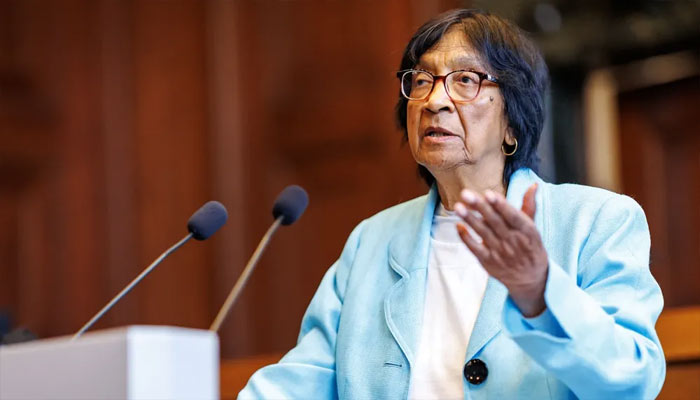
Nobel Peace Laureate Navi Pillay Defends International Justice Amid US Pressure
Navi Pillay, the South African-born jurist honoured with the Nobel Peace Prize last week, said she initially needed written confirmation before accepting the news of her award, reflecting the judicial principle of relying on evidence rather than assumptions.
“I received the letter in writing … so now I have read it for myself, and it’s true,” the 85-year-old told The Associated Press in an interview on Monday.
Pillay received the award for her work promoting international law at a time when global institutions and the principles underpinning the international legal order face mounting challenges. Her distinguished career includes defending the rights of imprisoned anti-apartheid leader Nelson Mandela, serving as a judge on three international courts and chairing a United Nations commission that concluded Israel had committed genocide in Gaza.
She described the recognition as an honour extending beyond her own achievements.
“To be honored for that kind of work is tremendous, not only for me, but for all my colleagues,” she said.
The Norwegian Nobel Committee’s decision coincided with the 125th anniversary of the Nobel Prize. Committee Chairman Jørgen Watne Frydnes said the award was intended to reinforce the importance of legal institutions in maintaining peace and resolving disputes without violence.
“The rule of law, national and international, underpins the system we have set up to ensure peace and resolve conflicts nonviolently. Peace requires justice,” Frydnes said.
Pillay’s selection has drawn attention amid opposition from US President Donald Trump and Israeli Prime Minister Benjamin Netanyahu to the findings of the UN commission she led on Gaza. Both leaders have also criticised the International Court of Justice (ICJ) and the International Criminal Court (ICC), institutions where Pillay has served as a judge.
Pillay welcomed the Nobel Committee’s emphasis on international justice, warning that disregard for the rule of law could have consequences far beyond individual countries.
“I value the focus of the selection committee on this important area, because it does affect the whole world if the rule of law is not respected,” she said.
She also criticised the Trump administration’s actions against the ICC, describing Washington’s campaign against the court as “completely unlawful” and “negative and cruel.” Trump has repeatedly expressed interest in receiving the Nobel Peace Prize.
Pillay argued that national leaders have a particular obligation to uphold legal principles and respect international law rather than undermine the institutions responsible for enforcing it.
Hours after the Nobel announcement in Oslo, US Secretary of State Marco Rubio announced sweeping new sanctions targeting the ICC. The measures formed part of Washington’s broader campaign against the institution, where Pillay previously served as a judge.
In response, Pillay urged countries to move beyond verbal expressions of support and take concrete steps to protect the court and the wider international legal framework.
She called for “collective action, not just words” from governments concerned about the future of international justice.
According to Pillay, public support for accountability remains strong, while the perception that powerful states can avoid scrutiny undermines confidence in the global legal system. She pointed to the United States and Russia, neither of which is a member of the ICC, while both hold permanent seats on the UN Security Council and can veto substantive resolutions.
Pillay has also faced fierce criticism from Israel over her leadership of the UN commission investigating events in Gaza. The commission concluded last year that Israel had committed genocide against Palestinians in the territory, including with the specific intent to destroy Palestinians in Gaza. Israel has strongly rejected the allegations and the commission’s findings.
Pillay dismissed Israel’s response, saying the criticism came from the state whose actions the commission had examined.
“We just have this condemnation by the state of Israel because they are the ones that we have held responsible,” she said.
Human rights organisations and several experts on genocide have also reached conclusions alleging that Israel’s actions in Gaza amount to genocide, although the issue remains contested and subject to legal proceedings.
Separately, the ICC has issued arrest warrants for Netanyahu over alleged war crimes and crimes against humanity in Gaza. Israel denies the allegations.
Despite the growing pressure on international institutions, Pillay said the development of international law is relatively recent in human history and that progress towards justice often takes time.
“Justice is slow, so we must not be impatient,” she said.
She nevertheless warned against complacency, urging people to assess international events critically, examine evidence and avoid accepting unverified claims.
“Don’t fall for false propaganda or just repeat slogans,” Pillay said, emphasising the importance of independently checking the evidence before reaching conclusions.
Comments are closed.