

France Sees Massive Protests as 1.6 Lakh Rally Behind Students Demanding Better School Conditions
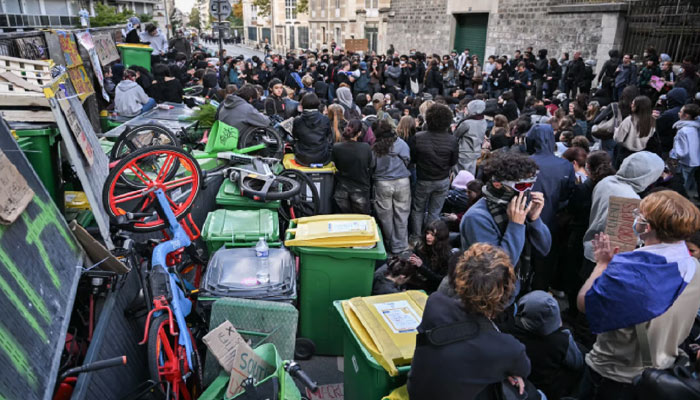
Tens of thousands of people took to the streets across France on Tuesday in support of high school students protesting against poor educational conditions, putting fresh pressure on President Emmanuel Macron’s government as his second and final term approaches its end.
According to France’s Interior Ministry, around 161,500 people participated in demonstrations nationwide, more than twice the 71,500 estimated during protests held the previous Thursday. However, French trade unions put the total turnout at 480,000, highlighting the scale of public mobilisation.
While most rallies remained peaceful, clashes broke out during demonstrations in Paris and Lyon. The protests have emerged as a significant challenge for the government, with growing public anger over school conditions, alleged police violence and wider economic concerns.
Clashes Erupt During Paris and Lyon Demonstrations
In Paris, where the Interior Ministry estimated that 41,500 people participated in two marches, violence broke out on the sidelines of one demonstration. Journalists from Agence France-Presse reported seeing cars set ablaze, while police fired tear gas in Place des Invalides as masked youths attempted to erect road barricades and threw objects.
Tear gas was also deployed during a demonstration in Lyon.
Swedish climate activist Greta Thunberg joined a rally in Saint-Denis, a suburb of Paris, expressing solidarity with the demonstrators.
“Our future is being robbed,” she said, explaining why she had joined the protest.
Demonstrations also took place in Nantes, Lens, Strasbourg, Toulouse, Bordeaux and Marseille, among other cities.
Students Demand Better Facilities and Dialogue
The student movement began last month, with pupils at lycées, France’s secondary schools for students aged approximately 15 to 18, blocking school entrances to draw attention to deteriorating educational conditions.
Their demands include more teachers, better-maintained school buildings, manageable timetables and improved classroom facilities. Students have also criticised the government’s response to their agitation, particularly what they describe as excessive police force.
“We stand in solidarity with the high schools that are worse off. We need real measures and proper dialogue, not repression,” said 16-year-old Emeline during a demonstration outside a school in Marseille.
Another student, 17-year-old Nina, said the protests reflected a widespread feeling that the government was not listening to young people.
The demonstrations have gained momentum following reports of serious injuries during earlier protests. One teenager reportedly lost a hand after picking up a police stun grenade, while another lost an eye. A third lost teeth after an officer fired a tear gas canister at close range.
Interior Minister Laurent Nunez said police had launched internal investigations into 36 allegations of violence against demonstrators. He also reported that nearly 900 police officers had been injured during the protests. Separately, the Education Ministry said 147 teaching staff members had sustained injuries.
Opposition Parties and Unions Back the Movement
The far-left France Unbowed (LFI) party has strongly supported the students, with its leader and presidential hopeful Jean-Luc Mélenchon seen among demonstrators in Paris.
The growing agitation comes at a politically sensitive time for Macron, whose second presidential term is nearing its conclusion. France is also preparing for a parliamentary debate on a cost-cutting budget, which faces opposition from both the left and right amid mounting concerns over the country’s public debt and pressure in bond markets.
The protests could also converge with a broader movement against the rising cost of living. National demonstrations are scheduled for Saturday, with unions and student organisations anticipating overlapping participation.
University students have also joined the campaign. Student union l’Union Étudiante reported that 90 per cent of universities had closed nationwide in solidarity with the movement. The Education Ministry, meanwhile, said 214 schools, predominantly high schools, were closed on Tuesday.
Students Reject Government’s Assurance
The government had pledged after last week’s demonstrations to deploy 3,000 substitute teachers to 114 schools facing the most severe staffing shortages. However, student groups have dismissed the announcement as inadequate and are continuing to demand broader improvements.
“We’re not giving up the fight, whether it’s for the high school students who were hit with a harsh crackdown, or for denouncing police violence,” said Patricia, a 20-year-old university student participating in the Paris rally.
Students have also indicated that school blockades could continue beyond the half-term holidays later in October.
“We are continuing the blockades. We are not budging,” said Naouel, a high school student in Brest, adding that she hoped the demonstrations would continue after the break.
Macron Calls for Restraint
On Monday, Macron urged protesters to exercise restraint, arguing that the issues raised by students required time, consultation, discussion and respect.
However, the government’s assurances have so far failed to satisfy the protesters, who want concrete action on staffing shortages, deteriorating infrastructure and allegations of police brutality.
With further cost-of-living demonstrations expected and student groups determined to maintain their campaign, the protests present the French government with a growing challenge as it navigates economic pressures and an increasingly charged political environment.
Comments are closed.