
Russia’s 600 kmph Drone Waves: How Mass Attacks Are Changing Modern Warfare

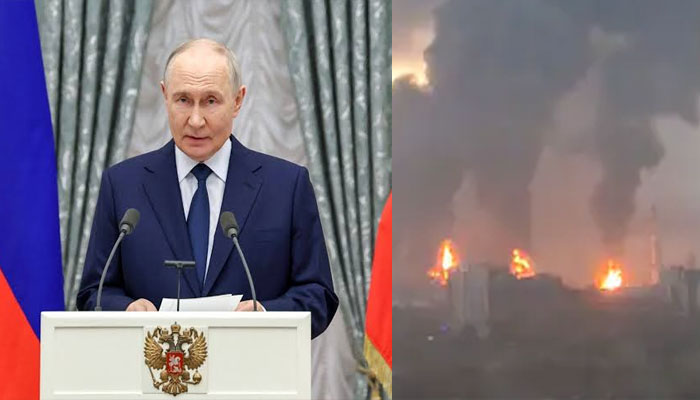
A new generation of Russian attack drones is creating a difficult challenge for Ukrainian air defences, combining high speed, long range and mass deployment in a way that is forcing Kyiv to rethink how it protects its cities and military infrastructure.
The Geran-5, the latest in Russia’s expanding Geran family, is reported to reach speeds of around 600 kilometres per hour and operate at altitudes of up to 6,000 metres. Its combination of drone economics and cruise-missile-like capabilities has made it particularly difficult for Ukraine’s existing counter-drone systems.
Maksym Zhorin, deputy commander of Ukraine’s 3rd Army Corps, recently summed up the challenge by saying Ukrainian forces “don’t know what to do about them.”
From Shahed Drones to Jet-Powered Gerans
Russia’s use of Iranian-designed Shahed-type drones in 2022 initially prompted Ukraine to develop relatively inexpensive countermeasures. Mobile anti-drone teams equipped with machine guns, specialised vehicles and short-range interceptors were able to destroy a large proportion of the incoming drones.
Russia subsequently altered its approach. The Geran series represents a shift from relatively slow, propeller-driven drones to faster, jet-powered systems.
Kateryna Bondar, a senior fellow at the Center for Strategic & International Studies, said the Geran family is produced in Russia based on the Iranian Shahed-136 design. The newer Geran-3, Geran-4 and Geran-5 variants use compact turbojet engines rather than piston engines and propellers.
According to Bondar, different variants can reach speeds ranging from around 300-400 kmph to approximately 600 kmph, with operating altitudes of up to 5,000-6,000 metres and ranges extending from roughly 450 km to more than 950 km.
That performance creates a problem for Ukrainian defences that were developed largely around slower drones.
Speed Is Changing the Interception Problem
Bondar said Ukraine’s earlier mobile defence units were particularly effective because they could use relatively inexpensive weapons against propeller-driven drones. Jet-powered Gerans reduce the effectiveness of that layer by combining speed with higher operating altitudes.
The faster flight profile also leaves defenders with considerably less time to detect, identify and engage an incoming target.
Some newer variants are also reported to have electronic warfare capabilities that can interfere with interceptor systems during the final phase of an attack.
Yuriy Cherevashenko, a deputy commander of Ukraine’s air force, highlighted another feature of the drones: their ability to alter their route and altitude through operator control.
This makes them more difficult to predict and complicates efforts to establish an effective interception window.
Russia Is Combining Technology With Numbers
The effectiveness of the Geran-5 does not depend only on its technical capabilities. Russia is also deploying the drones in increasingly large numbers.
According to Bondar, Russia launched roughly 450 jet-powered drones in June, with the figure increasing to about 2,850 in August. Jet-powered systems reportedly accounted for a significant share of the drones used in some attacks.
“Without volume, none of these tactics work,” Bondar said.
Large-scale attacks allow Russia to combine different flight paths, altitudes and decoys while forcing Ukraine to continuously deploy interceptors and air-defence crews.
Even a high interception percentage can leave a substantial number of drones reaching their targets when hundreds are launched simultaneously.
Bondar described this as a strategy of attrition against the air-defence network itself. Repeated attacks can consume missiles, exhaust personnel and create additional pressure on repair and replenishment systems.
Energy facilities, gas infrastructure, defence production sites and logistics networks can also be targeted while the repeated attacks place civilians under prolonged alert.
Why the Cost Equation Matters
James Patton Rogers, a drone expert and lecturer in the Department of War Studies at King’s College London, said the move to jet propulsion represents an important development in one-way attack drones.
By replacing the original piston engine with a jet engine, Russia has created a system that is faster and harder to intercept while remaining less expensive than many conventional cruise missiles.
That difference matters because air defenders can be forced to use considerably more expensive weapons against comparatively cheaper attacking drones.
The objective, therefore, is not necessarily to make every drone individually unstoppable. Instead, large numbers can force defenders to spend scarce resources simply to prevent a percentage of the incoming weapons from getting through.
Ukraine Searches for a New Response
Ukraine has been aware of the jet-powered threat for months, with intelligence officials identifying wreckage and documenting the deployment of the newer drones.
But developing an affordable countermeasure has proved difficult.
Ukraine invited manufacturers to test a new generation of interceptor drones in July. Reuters reported that some systems struggled to maintain control at speeds above 400 kmph, with several crashing during testing.
Ukrainian forces are exploring several approaches, including faster interceptors, lower-cost guided missiles, electronic warfare and attempts to manipulate the navigation systems of incoming drones.
Another concept involves interceptors approaching the target head-on rather than trying to chase a faster drone from behind.
Bondar said Ukraine would need a layered defence system rather than relying on one technology. She pointed to the development of high-speed interceptors, improved sensors and automated targeting systems as immediate priorities.
She also argued that disrupting Russian production and supply chains could become another part of Ukraine’s response, alongside attacks on launch infrastructure and electronic warfare.
A Broader Lesson for Air Defence
The emergence of the Geran-5 highlights a wider problem facing militaries around the world: defending against large numbers of relatively inexpensive aerial weapons without exhausting costly interceptors.
Rogers said future air-defence systems will need to focus not only on improving interceptor technology but also on finding affordable methods of defeating drone swarms and disrupting the supply chains that sustain them.
Bondar described the Geran-5 as a mass-produced deep-strike weapon that combines the reach associated with cruise missiles with the economics of drones.
However, she said the development does not make conventional missiles obsolete.
Ballistic and cruise missiles retain advantages against hardened, heavily defended or time-sensitive targets. Instead, the two categories are increasingly being used for different purposes: drones can provide volume and pressure on air defences, while more expensive missiles can be reserved for targets where precision and destructive capability are considered more important.
The result is a changing balance in air warfare, where the ability to produce, deploy and intercept weapons at scale can be as important as the performance of any individual missile or drone.
Comments are closed.