

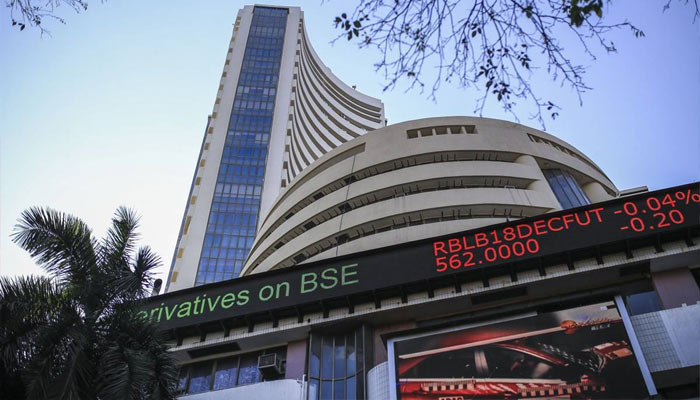
Indian equity markets closed lower on Wednesday as rising crude oil prices, renewed concerns over Middle East tensions and weakness in several Tata Group stocks weighed on investor sentiment.
The BSE Sensex fell 187.90 points, or 0.24%, to settle at 77,966.35. The NSE Nifty 50 declined 35.75 points, or 0.15%, ending the session at 24,435.95.
The Indian rupee also weakened against the US dollar, falling 0.14% to 95.4350. Higher crude prices raised concerns over the country’s import bill and added to broader market pressure.
Tata stocks weigh on benchmarks
Several heavyweight stocks came under selling pressure. TCS was the biggest major laggard, declining 3.71%, while Mahindra & Mahindra fell 1.67% and Tata Steel slipped 1.57%.
Tata Group companies remained under pressure following the exit of group chairman N Chandrasekaran, contributing to weakness in large-cap stocks.
The broader market, however, saw gains in select counters. State Bank of India advanced 1.31%, while Bharti Airtel gained 1.16%. UltraTech Cement rose 0.56%, with Reliance Industries and Bharat Electronics adding 0.45% and 0.50%, respectively.
Vinod Nair, Head of Research at Geojit Investments, said investors remained cautious ahead of key inflation data from India and the US, with global uncertainty continuing to influence sentiment.
Crude prices add to inflation concerns
Oil prices climbed sharply, with Brent crude rising 2.22% to $89.67 a barrel and West Texas Intermediate gaining 2.36% to $84.07.
Uncertainty surrounding the Strait of Hormuz and the outlook for a possible US-Iran agreement continued to support oil prices. Expectations of a deal that could ease geopolitical tensions and restore smoother shipping through the key route have weakened.
Higher crude prices are particularly significant for India, which relies heavily on imports to meet its oil requirements. A sustained rise in energy prices could increase the import bill, put pressure on inflation and raise input costs for businesses.
Nair said the rebound in crude had revived inflation concerns and encouraged a more cautious approach among investors. He added that uncertainty over the Strait of Hormuz and US-Iran negotiations kept markets on edge ahead of the upcoming inflation readings.
PSU banks outperform
Public sector banks bucked the broader market weakness, supported by strong asset quality, attractive valuations and expectations of healthy credit growth.
Metal stocks also performed relatively well as investors anticipated tighter supply conditions.
According to Nair, robust foreign fund inflows and encouraging corporate earnings helped limit the downside despite the challenging global backdrop.
IT, FMCG stocks decline
Sectoral performance remained mixed. Nifty Infrastructure gained 0.27%, while Nifty Energy rose 0.18% and Nifty Pharma edged up 0.05%.
In contrast, Nifty IT declined 1.54%, Nifty FMCG fell 0.73% and Nifty Consumer Durables dropped 0.45%. Nifty Auto also ended 0.32% lower.
The Nifty Smallcap 100 index slipped 0.18%, while the India VIX, a gauge of market volatility, declined 1.58%.
With crude prices, geopolitical risks and upcoming inflation data likely to remain key drivers, investors are expected to closely track global developments and interest-rate signals in the coming sessions.
Comments are closed.