

Europe Gripped by Fresh Wave of Protests as Clashes, Looting and Heavy Security Mark Weekend
Europe witnessed another turbulent weekend on Saturday as large crowds took to the streets in France, Italy, Spain, Portugal, Albania and Belgium, protesting over economic hardship, housing costs, education, public services and government policies. While several rallies remained peaceful, incidents of violence, shop looting and clashes with law enforcement forced authorities to step up security measures across major cities.
France reported nearly 1,000 arrests amid demonstrations across the country, while Italy deployed an additional 500 soldiers to Milan following violence during the previous weekend. In Spain, Barcelona saw shops looted and fires set in public spaces. Police in Rome, Turin, Brussels and Tirana resorted to tear gas or water cannon to disperse demonstrators.
Although the protests stem from different local issues, their simultaneous occurrence has highlighted mounting public frustration across parts of Europe. Rising living expenses, unaffordable housing, low wages and dissatisfaction with government decisions have featured prominently, alongside concerns over military spending and the war in Gaza.
FRANCE: MASS DEMONSTRATIONS LEAD TO NEARLY 1,000 ARRESTS
France remained one of the main centres of unrest, with the Interior Ministry estimating that approximately 410,000 people participated in Saturday’s demonstrations. Trade unions, however, placed the turnout at around 800,000.
Authorities mobilised nearly 70,000 police officers and introduced restrictions in several cities to prevent the protests from descending into widespread disorder.
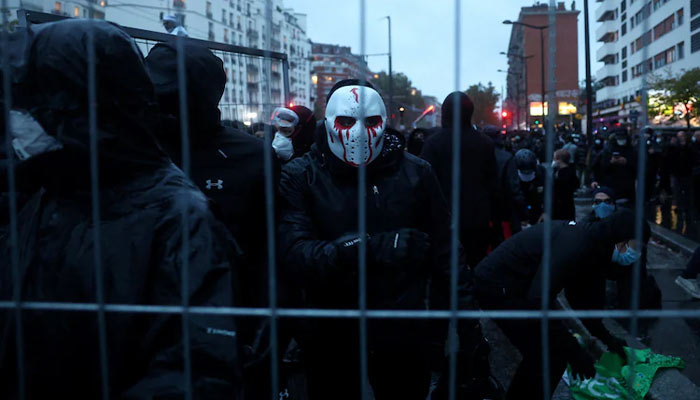
Although many demonstrations remained peaceful during the day, confrontations broke out in Paris and other urban centres later in the evening. In the French capital, a march between Porte d’Italie and Porte de Vincennes ended in clashes between riot police and groups of protesters.
Some demonstrators erected makeshift barricades and hurled projectiles at officers, while masked individuals smashed windows at a car dealership. Police responded with baton charges, tear gas and water cannon.
Interior Minister Laurent Nunez said several thousand radical activists had gathered towards the rear of the march, including around 500 people identified as rioters, according to AFP.
Violence was also reported elsewhere. In Marseille, rubbish bins were set alight and metal sheets were used to obstruct roads. In Bordeaux, masked demonstrators removed wooden boards from a building to construct barricades, while police in Lyon used tear gas to disperse a crowd gathered in an area where demonstrations had been prohibited.
Despite the confrontations, the destruction was reportedly less extensive than during the previous weekend, when businesses were targeted and buildings were set on fire.
President Emmanuel Macron’s government had earlier restricted authorised demonstrations to those organised by recognised trade unions. Authorities have also pursued expedited court proceedings against people arrested over alleged vandalism, arson and looting.
ITALY: ADDITIONAL TROOPS SENT TO MILAN AS POLICE PREPARE FOR DISORDER
Italy saw demonstrations in Milan, Rome and Turin, with protesters raising concerns about living costs, low wages, public services, military expenditure and government policies.
Milan remained on heightened alert after last weekend’s looting and clashes. Prime Minister Giorgia Meloni announced that another 500 soldiers would be deployed to the city, supplementing the personnel already stationed there.
Security agencies increased surveillance through drones, railway station checks and rapid-response teams. Several luxury retailers and prominent shops boarded up their windows, while the Apple Store remained closed even after some businesses resumed operations.
The main march in Milan was largely peaceful. Protesters chanted slogans against Meloni’s government and displayed banners criticising its policies. Some demonstrators dumped manure outside the country’s energy regulator and burned an oversized electricity bill to draw attention to rising energy costs.
The situation was more volatile in Rome, where police deployed tear gas and water cannon after some demonstrators threw bottles and fireworks. Street signs were also damaged.
Separately, several hundred students and young demonstrators briefly occupied the Colosseum, waving Palestinian flags and protesting against the war in Gaza and the Italian government’s position.
In Turin, police used tear gas after demonstrators allegedly threw stones, bottles and smoke bombs at officers.
The government has announced tougher security measures and stricter penalties for minors involved in violence, following reports that young people accounted for a significant proportion of those involved in the previous weekend’s unrest.
SPAIN: BARCELONA HIT BY LOOTING AND FIRES, AROUND 100 ARRESTED
Barcelona witnessed serious disturbances on Saturday evening, with around 100 people arrested after masked demonstrators looted shops and set fire to street furniture near Plaça de Catalunya.
Catalonia’s regional Interior Minister, Núria Parlon, said authorities recorded more than 30 fires and reported vandalism or looting at 14 stores. Approximately one-quarter of those arrested were minors.
The protests followed social media calls for an anti-establishment movement, with some online posts drawing on slogans associated with student demonstrations in France.
Videos circulating online showed masked individuals dressed in black breaking shop windows and removing merchandise. Other footage showed people trapped inside commercial premises, including the El Corte Inglés department store, after shutters were lowered to prevent looting.
Barcelona Mayor Jaume Collboni warned that vandalism would have legal consequences and said the guardians of minors involved could also face repercussions.
Madrid witnessed a separate demonstration, where more than 25,000 people reportedly took to the streets to demand reforms to the pension system.
The contrasting demonstrations illustrated the variety of concerns motivating public mobilisation in Spain, ranging from opposition to the establishment to questions surrounding pensions and economic security.
PORTUGAL: HOUSING AFFORDABILITY TAKES CENTRE STAGE
In Portugal, thousands of demonstrators marched in several cities to demand more affordable housing as rents and property prices continued to rise.
In Lisbon, protesters criticised government measures intended to ease rent increases and facilitate the eviction of tenants who fail to pay. Demonstrators argued that rising property costs were making it increasingly difficult for residents to secure affordable homes.
Unlike the violent confrontations reported in parts of France, Italy and Spain, the Portuguese demonstrations focused primarily on housing policy and the growing pressure on household budgets.
The rallies underscored how the cost of accommodation has become a major source of public concern, particularly for residents struggling to keep pace with rising rents and property prices.
ALBANIA: STUDENTS SEEK LOWER FEES AND CALL FOR PRIME MINISTER’S RESIGNATION
In Albania, demonstrators gathered outside the Ministry of Education in Tirana, demanding reduced tuition fees, increased public investment in education and the resignation of Prime Minister Edi Rama.
Students joined a broader anti-government mobilisation as dissatisfaction over education costs merged with wider criticism of the administration.
Some protesters threw stones at police and buildings, prompting officers to use water cannon to disperse the crowds. More than 2,500 police personnel were deployed in the capital.
Demonstrators also set fire to dumpsters and cushions that Rama had placed outside as a symbolic invitation for dialogue with students.
The confrontation highlighted the challenge facing authorities as demands over education and public spending increasingly overlap with broader political grievances.
BELGIUM: TEAR GAS AND WATER CANNON USED AGAINST PROTESTERS IN BRUSSELS
In Brussels, Belgian police deployed tear gas and water cannon to disperse crowds and break up student barricades. High-end retailers and luxury boutiques boarded up their premises amid concerns about possible looting and property damage.
During one incident, demonstrators reportedly attempted to set fire to a pile of rental scooters, road signs and bicycles. Reuters witnesses also reported that a police officer hit and kicked a protester during a confrontation.
At least five people were arrested, although police said there had been no major incidents.
The precautionary measures reflected concerns that the disorder seen in other European cities could spread, prompting authorities and businesses to prepare for further disturbances.
EUROPEAN GOVERNMENTS UNDER PRESSURE AS PUBLIC ANGER PERSISTS
The latest demonstrations have exposed the diversity of grievances driving protests across Europe. While economic pressures provide a common backdrop, the immediate demands vary considerably between countries.
Housing affordability has dominated rallies in Portugal, education costs have fuelled student protests in Albania, and concerns over wages, public services and government policies have featured prominently in France and Italy. Protests in Italy have also included opposition to military spending and the government’s position on Gaza.
Authorities have responded with extensive police deployments, additional military personnel, restrictions on demonstrations and preventive security measures, particularly in cities that experienced violence during the previous weekend.
However, the continuation of demonstrations across multiple countries suggests that security measures alone may not resolve the concerns behind the unrest. Governments face the difficult task of preventing violence while addressing public dissatisfaction over living standards, access to housing, education and the quality of public services.
With businesses reinforcing security and authorities remaining on alert, attention is now turning to whether the latest deployments will prevent further clashes or whether demonstrations will continue in the coming days.
For European governments, the immediate priority remains restoring public order. The longer-term challenge will be responding to the economic and political concerns that continue to bring people onto the streets.
Comments are closed.