
The Brutalist director Brady Corbet on besting Payal Kapadia at Golden Globes: ‘She’s an extraordinary filmmaker’

Brady Corbet is going into the Academy Awards with some good momentum.
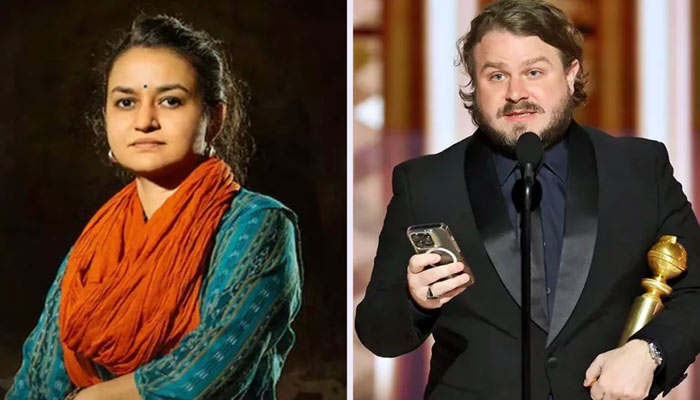
The Brutalist director clinched the Best Director honour at the Golden Globes, besting India’s Payal Kapadia, who was nominated for her debut feature film All We Imagine As Light. Brady, along with his wife and The Brutalist co-writer Mona Fastvold, assured Hindustan Times how proud they’re of young female Indian filmmakers like Payal.
On the American dream and legacy
“Payal is an extraordinary filmmaker. My pal Chaitanya Tamhane is also an extraordinary director. I’m very, very supportive of more films from India being internationally recognised. We have a lot of conversations about gender parity at festivals every year. But how frequently is a nation that produces as much cinema as yours is underrepresented at these festivals is something I find baffling and appalling,” says Brady, adding, “I’m extremely excited for Payal’s success. It’s extremely deserved. I hope it means a new wave for Indian cinema, especially from young female filmmakers like herself.”
“That’s what we were hoping for. I said to Brady the other day, ‘Is there an Indian Wave happening?’ Like what happened in Mexico City. Maybe that’s what’s on the rise,” adds Mona. The filmmaker couple agree that like their film which speaks of the Holocaust survivors migrating to America, Payal’s film also documents migrants, though from one part of India to another, and their struggle to make an identity and living in a harsh city like Mumbai. And like Payal’s story, which moves from Mumbai to a coastal Maharashtrian village, The Brutalist is also more of a warning against the pursuit of the American dream.
“I think because we’ve had plenty of the success story. The reality is, if we just look at the data, we’ve been selling the American dream to 99% of the population that it actually doesn’t function for. And that’s just a fact. It seems a little bit strange for me to try and spin it any other way. Ecstacy is always accompanied by agony and vice-versa,” points out Brady. Adrien Brody’s character László Tóth ends up as a ‘successful’ architect, but the idea of that success is quite complicated. As the film ends, Brady sees him age more than flourish. “When Chet Baker (popular jazz trumpeter) was 80, he looked like a 50. Our protagonist is 80, and he looks like 99 going on 1,000 years old. So he’s a shell of himself at the end of his life, unable to speak. Presumably, his wife at that point is dead,” Brady underlines.
He laments that after all the lifelong struggle, László didn’t have much to show for. “What is his legacy? His legacy is not his body of work. His legacy is his niece and his family,” says Brady, who believes making a film like The Brutalist is more of a “creative compulsion” for him and Mona. Their legacy, in fact, lies in their 10-year-old daughter Ada, who cried and proudly held the Golden Globe statuette on stage as her parents received the award for Best Picture – Drama. The couple had been making The Brutalist for seven years, when their daughter was just three. They even compare it to one of the great buildings László would architect in the film, hoping it lasts a lifetime.
On constructing The Brutalist
“It was definitely a cathartic experience. We exercised some demons during the process. It’s a similar process to erecting a building, just dealing with hundreds of people, gathering a crew, working on a specific, unique vision. It definitely has a lot of similarities,” says Mona. Brady, however, sounds more excited. “Every project is a hell of your own devising. It feels a very strange thing to be compelled to do over and over again. I feel like Sisyphus. You’re essentially pruning a tree for, I don’t know how many years. That’s what it really is. You’re working on it a little every single day until it’s done,” he says, heaving a sigh accompanied by a smile.
Which is why he distinctly remembers the day he was finally done. “There’s also no greater ecstacy than finishing. Everything that has followed has been very moving, but the reality is I don’t think there’s been a greater moment for us than the day that we were finally done. The object existed and there it was, a tangible object on 70 mm. We weren’t just sending the hard drive to shout into the void,” says Brady. “If we plan to have another film off the ground in another seven years, then we need to start immediately. We never really have any time to put our feet up and reflect. The only way out is through,” he adds.
Time is also a character in The Brutalist. The 3-hour-35-minute film is one of the longest in recent Hollywood history. There’s even an interval built into the movie. Yet Brady and Mona felt it wasn’t compatible to TV. “Television is not a director’s medium. It’s very expensive to produce because it’s many, many hours long. When you’re making something that expensive, then you are inviting a look of cooks into your kitchen. I think that’s a format we’ve worked a little bit in. Unfortunately, we’re not living in the era of Fanny and Alexander (1982) or Like A Bird On The Wire from (Rainer Werner) Fassbender (1990) or any other films that were made for television in the bygone era. For us, this was always a film,” reasons Brady.
Maybe could have made it into a show, and leave scope for more seasons? “I think 3.5 hours is enough time with these characters. I feel pretty good. I’m personally finished,” says Brady, channeling his trademark exhaustion. Mona seems to second, “I could’ve indulged further, but as Brady says, you don’t have the freedom. We made this film for $10 million and shot it in 33 days. You couldn’t have made or planned it for that budget and schedule for television. It just wouldn’t have been possible.”
On love and longing
The runtime is also a reason why the writers are in no rush to introduce the female lead Erzsébet (Felicity Jones), who enters only close to the second half. Brady called Alfred Hitcock an inspiration as he loves inverting the auteur’s Janet Leigh effect. While Janet was scandalously killed in the first half of Psycho (1960), Natalie Portman’s lead character was introduced only in the second hour of Brady’s previous film, Vox Lux (2018).
“That’s the magic trick. Imagine sending a screenplay to someone’s agent and saying, ‘Just flip to page 60 and there you’ll find the lead of the movie.’ It wasn’t very popular at the time. But movies used to take bigger risks. It’s incredible that 75 years ago, people were taking much bigger swings than they are now,” says Brady. However, Felicity’s late entry didn’t worry Mona much, as her character made her presence right from the beginning, via her husband’s longing. “It’s very prescient from the beginning. The idea was that you’d anticipate her, long for her together with László (Adrien Brody),” Mona says.
“That you’re wondering about this character because you do get to know her through that letter. You hear her voice, there’s intimacy in that. Hopefully, you understand the nature and uniqueness of their relationship right away so that her presence is there throughout. Also, once you realise that he doesn’t know that she’s alive until later, you also see how incredibly lost he is when he thinks that she’s gone forever. Seeing that journey would hopefully help you join his experience when they’re reunited,” Mona explains further. Like their protagonists, Brady and Mona also had to devise a way to work together better, without their individual needs coming into conflict.
“We’ve done all of our projects together in one way or another. Apart from writing with each other, we also direct the second unit on each other’s films and produce each other’s films. So the whole process is symbiotic from the beginning till the end. We just wear different hats in the various parts of the process,” says Mona, who feels it helped to define roles that they started out as writing partners before they were a romantic couple. “In this film, we show a character who’s all consumed by what he’s making. And we show a partner who’s quite supportive of that, but at the same time, would nudge him and say, ‘Your ego has taken over now.’ She pulls him back down to the earth again and grounds him, but never challenges his artistic vision. So we try to be that for each other throughout the various projects,” adds Mona.