
Three Economists Awarded Nobel Prize for Research on Innovation-Driven Economic Growth

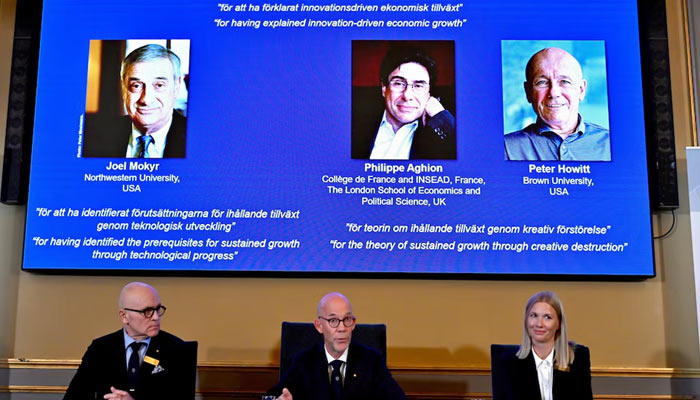
Nobel Prize in Economics Awarded to Three Researchers for Work on Innovation-Driven Growth.
Philippe Aghion and Peter Howitt were awarded the Nobel Memorial Prize in Economic Sciences on Monday, alongside economic historian Joel Mokyr, for their groundbreaking work on innovation-driven economic growth and the principle of creative destruction.
The laureates bring complementary approaches to understanding growth. Mokyr, 79, of Northwestern University, used historical analysis to trace long-term economic trends, while Aghion, 69, of the Collège de France and the London School of Economics, and Howitt, 79, of Brown University, employed mathematical models to explain how creative destruction — the process by which new innovations replace outdated technologies and businesses — drives sustained economic growth.
Aghion expressed surprise at receiving the honor. “I can’t find the words to express what I feel,” he said in a press conference from Stockholm, adding that he plans to invest his prize money in his research laboratory. On current global trade tensions, he cautioned against protectionism, saying it “is not good for world growth and innovation.”
The Nobel Committee credited Mokyr with demonstrating that successful innovation requires not only trial and error but also scientific understanding of why certain innovations succeed. Aghion and Howitt were recognized for developing a mathematical framework to explain the mechanisms behind sustained growth, including their influential 1992 model of creative destruction.
Aghion has also been involved in shaping policy, advising French President Emmanuel Macron during the 2017 election campaign and co-chairing the 2024 Artificial Intelligence Commission, which produced recommendations for France’s AI strategy.
John Hassler, Chair of the Nobel Committee for Economic Sciences, said: “The laureates’ work shows that economic growth cannot be taken for granted. We must uphold the mechanisms that underlie creative destruction to avoid stagnation.”
The prize, formally known as the Bank of Sweden Prize in Economic Sciences in Memory of Alfred Nobel, carries a cash award of 11 million Swedish kronor (nearly $1.2 million), a gold medal, and a diploma. Mokyr receives half of the prize money, while Aghion and Howitt share the other half.
The economics award, first established in 1968, has been presented 56 times to 96 laureates. Only three women have won the prize to date. It is announced alongside the five original Nobel Prizes on Dec. 10, the anniversary of Alfred Nobel’s death.
Comments are closed.