

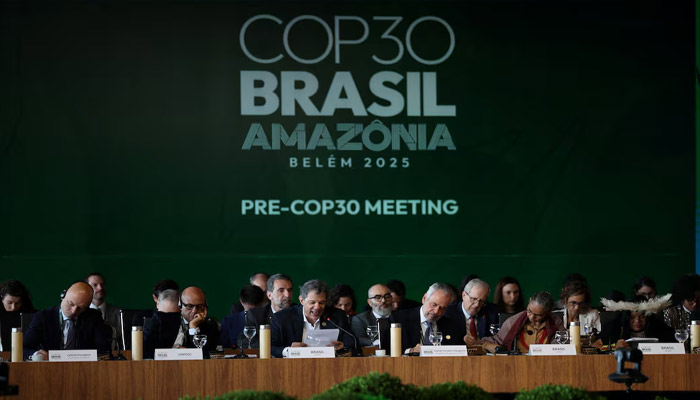
UN Warns World Still Off Track to Meet Paris Climate Goals Ahead of COP30.
With global leaders preparing for COP30 in Brazil, the United Nations Environment Programme (UNEP) has issued a stark warning: while some progress has been made in cutting greenhouse gas emissions, it remains far from sufficient to prevent a dangerously warming planet.
The 16th annual Emissions Gap Report shows that the world is slowly moving forward on climate action but remains on a trajectory toward temperature rises that could trigger widespread floods, wildfires, and food shortages. In short, the global “report card” indicates incremental improvement but failure to meet the ambitions of the 2015 Paris Agreement.
Global Warming Projections and Emission Gaps
- If all current climate pledges (Nationally Determined Contributions, or NDCs) are fully implemented, the planet is expected to warm by 2.3–2.5°C by 2100, slightly lower than last year’s 2.6–2.8°C projection.
- Present policies, reflecting what governments are actively doing, still put the world on track for 2.8°C of warming, improved from 3.1°C last year, but still catastrophic.
- Modest improvements are largely due to calculation updates, and some progress may be undone by actions like the US’s planned withdrawal from the Paris Agreement.
To limit warming to below 2°C, global emissions must fall 35% by 2035 from 2019 levels. Achieving the 1.5°C target requires a 55% reduction by the same year. However, emissions actually rose 2.3% last year, reaching a record 57.7 gigatons of CO₂ equivalent, with G20 nations—responsible for 77% of global emissions—off track to meet 2030 targets.
1.5°C Threshold Will Be Temporarily Crossed
The report notes that a temporary overshoot of the 1.5°C limit is “inevitable” within the next decade, heightening risks of extreme weather, ice sheet melt, and other climate impacts. Yet, deeper and faster emission cuts could cap the overshoot at roughly 0.3°C and bring global temperatures back toward 1.5°C by 2100. UN Secretary-General António Guterres emphasized, “This is no reason to surrender. It’s a reason to step up and speed up.”
Country-Level Action
Only about one-third of Paris Agreement signatories, covering 63% of emissions, submitted updated NDCs by the September 30 deadline. Among G20 nations, only seven submitted 2035 targets, and three more announced them after the deadline. The group collectively saw a 0.7% rise in emissions in 2024.
India’s Position
India has not yet submitted its updated 2035 NDC. However, it is on track to exceed its current 2030 targets, having achieved 50% non-fossil energy capacity ahead of schedule and poised to surpass its 45% emissions-intensity reduction goal. Despite a 6.1% emissions increase in 2023-24, India’s low per-capita emissions (2.9 tCO₂e) and continued renewable expansion provide scope for stronger commitments if developed nations deliver promised climate finance.
Opportunities and Challenges
Renewable energy is booming, with falling solar and wind costs creating economic incentives beyond climate benefits. Methane mitigation, green transitions, and existing technology offer realistic solutions. Yet geopolitical tensions, financing gaps for developing nations, and outdated global finance systems remain significant obstacles. UNEP Executive Director Inger Andersen urged a decisive “all-in” approach, particularly from G20 countries, to close the emissions gap.
The Path Forward
Since the Paris Agreement, projected warming has dropped from 3–3.5°C due to technological progress and incremental policy action. To meet climate targets, nations must accelerate emissions reductions, increase ambition, and ensure equitable climate finance. COP30 represents a critical moment to signal that global climate action is moving from promises to measurable outcomes.
Comments are closed.