
UPI Fee Row Escalates: Congress Calls It ‘Modi Tax’, BJP Responds With ‘Jhooth Ki Dukaan’

The introduction of a new Merchant Discount Rate (MDR) on certain UPI payments has triggered a political dispute, with the Congress calling it a “Modi tax” and the BJP accusing the opposition of spreading misinformation about the new framework.
Under the framework announced on September 15, a 0.4% MDR will apply to specified person-to-merchant (P2M) UPI transactions above ₹2,000, with the charge capped at ₹300 for transactions of ₹75,000 and above. The government has clarified that the MDR is part of the merchant payment ecosystem and is not a tax collected from customers.
What Has Changed for UPI Payments?
The new framework does not impose a charge on person-to-person (P2P) UPI transfers. Such transactions will continue to remain free, regardless of the amount involved.
Merchant payments of up to ₹2,000 will also remain free of MDR. The government says around 96% of P2M UPI transactions will remain unaffected under the new system.
Small merchants receiving up to ₹1 lakh per month through UPI QR codes under the specified P2PM category will also continue to receive payments without MDR.
For merchant transactions above ₹2,000, the MDR will generally be 0.4%, while transactions of ₹75,000 or more will have a maximum MDR of ₹300. Certain essential sectors, including railways, telecommunications, insurance, fuel and agricultural inputs, will instead attract a flat ₹5 MDR on transactions above ₹2,000.
The government has also stated that banks must ensure merchants do not pass the MDR on to customers, while UPI apps are prohibited from imposing platform fees or hidden charges on such payments.
Congress Calls It ‘Modi Tax’
The Congress criticised the new framework soon after its announcement.
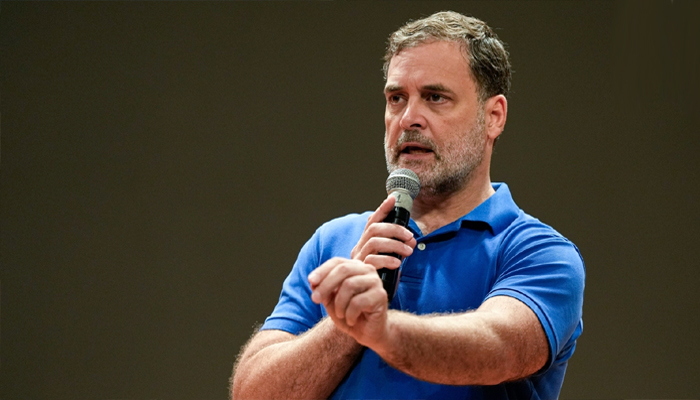
Congress leader Rahul Gandhi alleged that the government had paved the way for charging fees on UPI merchant transactions and questioned whether merchants could ultimately pass the additional cost on to consumers.
Congress communications chief Jairam Ramesh also pointed to earlier government statements that no MDR framework had been finalised, arguing that the subsequent notification represented a reversal.
Party leader Pawan Khera referred to the 0.4% MDR as the “Modi Tax”, while Congress president Mallikarjun Kharge also criticised the move.
BJP Accuses Congress of Spreading ‘Fake News’
The BJP rejected the Congress’s allegations and said the new MDR does not amount to a charge on ordinary UPI users.
BJP spokesperson Pradeep Bhandari accused the Congress of being a “jhooth ki dukaan” and said claims that consumers would be charged for UPI payments were misleading.
The government has similarly emphasised that MDR is not a tax and is not collected by the government or NPCI. Instead, it is distributed among participants in the payment ecosystem, including banks and payment service providers.
Why Has MDR Been Introduced?
According to the Finance Ministry, the framework is intended to support the long-term sustainability of the UPI ecosystem and help fund continued investment in payment infrastructure, cybersecurity and other services.
The government had already said in August that any future MDR would be threshold-based rather than a blanket charge on UPI transactions.
The latest framework therefore applies only to specified merchant transactions above the ₹2,000 threshold, while individual transfers and most merchant transactions remain outside the MDR system.
The political debate, however, is likely to continue over whether merchants will absorb the MDR or whether businesses could seek to recover the cost through their pricing, despite the government’s direction that the charge should not be passed on to customers.
Comments are closed.