

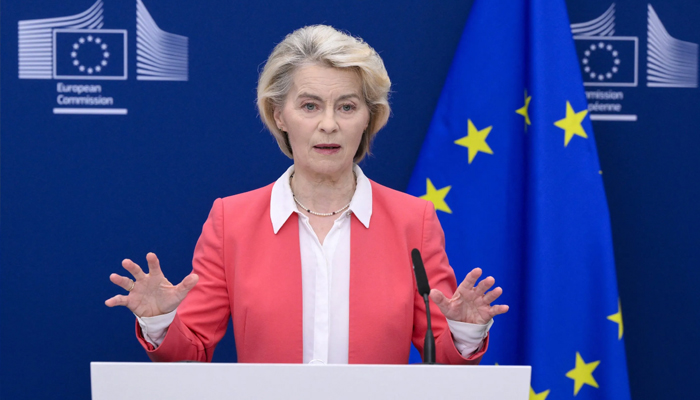
European Commission President Ursula von der Leyen is set to unveil plans aimed at strengthening protections for children online, including proposed restrictions on access to social media, video-sharing platforms, online games and AI chatbots for younger users.
The proposals come amid growing international concern over the impact of digital platforms on children’s wellbeing. Policymakers in several countries are examining age limits and other safeguards as research continues to highlight potential risks associated with excessive or poorly regulated online activity.
Australia became the first country to introduce a nationwide social media ban for children under 16 last year, while several other governments have since considered similar measures.
EU Proposes Age-Based Online Restrictions
According to a draft document seen by AFP, the European Union is considering a tiered system governing children’s access to social media, AI services and online gaming.
Under the proposed framework:
- Those aged 15 and above would be able to create their own accounts on social media, AI and gaming platforms.
- Children aged 13 and 14 could receive limited “introductory” accounts, but only under parental control and with restrictions on features and screen time.
- Children aged 3 to 13 would have access only to fully parent-controlled accounts on designated child-friendly services meeting strict safety requirements.
- Children under 3 would have no access under the proposed system.
The draft also proposes restrictions on design features considered potentially addictive, including infinite scrolling, particularly where children are concerned.
Platforms that fail to comply with the proposed rules could face penalties of up to 6% of their annual turnover, according to a separate document cited by AFP.
EU KIDS Act to Follow
Von der Leyen is expected to outline the plans during her annual address to the European Parliament in Strasbourg. The European Commission’s technology chief, Henna Virkkunen, is due to formally present the proposed “EU KIDS Act” on Thursday.
The initiative follows pressure from several EU member states, including France, Denmark and Greece, for bloc-wide measures to protect children online.
The EU has already used its Digital Services Act (DSA) to demand changes from major platforms, including Meta’s Facebook and Instagram and TikTok, over concerns about potentially addictive design. However, the European Commission has indicated that existing rules have not produced all the changes it considers necessary.
Privacy and Age Verification Concerns
The proposed restrictions have also raised concerns among digital and children’s rights organisations.
One issue is the EU’s planned age-verification system. Consumer and digital-rights groups have warned that requiring users to prove their age could create privacy and data-protection risks.
Agustin Reyna of the European consumer organisation BEUC said age verification should not be viewed as a complete solution and could raise significant privacy concerns.
Digital rights advocates have also questioned whether simply restricting access by age addresses the underlying design and safety problems on online platforms.
Simeon de Brouwer of European Digital Rights (EDRi) argued that age restrictions could delay children’s exposure to potentially harmful platforms without addressing the systems that contribute to those risks.
Concerns Over Addictive Design
Research cited by children’s advocacy group 5Rights Foundation has highlighted features such as notifications, endless scrolling and autoplay as mechanisms that can encourage users to remain on platforms for longer periods.
The organisation examined nine popular services spanning video-sharing platforms, AI chatbots and online games and reported that some used what it described as manipulative design techniques.
These included notifications designed to create an emotional response, such as messages framed as if they came from a friend who “missed” the user.
Supporters of stronger regulation argue that such design practices demonstrate the need for additional safeguards rather than relying solely on parental supervision.
Proposal Still Has to Become Law
The proposed EU measures are not yet law. After the European Commission formally presents its proposal, it will have to go through negotiations involving EU member states and the European Parliament.
That process could take several months, and the final legislation could differ from the current draft.
The debate is likely to continue over how best to balance children’s safety online with privacy, freedom of expression, parental rights and access to digital services.
Comments are closed.