

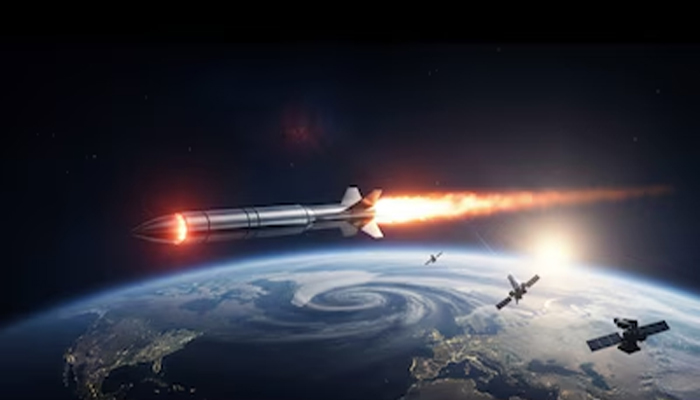
The United States has acknowledged for the first time that it has offensive weapons deployed in space, marking a significant development in the militarisation of the space domain.
The US Space Force said the country possesses “on-orbit” space-control weapons designed to protect American forces from hostile actions.
US Air Force Secretary Troy Meink confirmed the existence of the capability while speaking at the annual Air, Space and Cyber Conference in National Harbor, Maryland. Although he did not disclose what type of weapon is currently deployed, he said the system was necessary to counter emerging threats and maintain US control of space.
The disclosure comes as the Trump administration accelerates efforts to strengthen America’s capabilities in space under its proposed “Golden Dome” missile defence initiative, which is intended to protect the United States from missiles and other airborne threats.
What Are US ‘On-Orbit’ Weapons?
The US Space Force has not revealed the specific nature of the weapons. In a statement, however, a spokesperson said the United States has “on-orbit space control weapons” capable of protecting the Joint Force against hostile actions by adversaries.
According to the Space Force, space control involves operations designed to contest and control the space domain. These can include both kinetic and non-kinetic methods intended to disrupt or affect an adversary’s space-based capabilities.
The military branch said such capabilities can serve both offensive and defensive purposes, suggesting they could potentially be used to counter threats to US satellites and other critical space infrastructure.
Space Militarisation Dates Back To The Cold War
The competition to establish military capabilities in space is not new. The US and Soviet Union began exploring the military potential of outer space soon after the launch of Sputnik in 1957.
One of the biggest concerns during the Cold War was the possibility of placing nuclear weapons in orbit. The 1967 Outer Space Treaty subsequently prohibited the placement of weapons of mass destruction in orbit around Earth.
However, the treaty did not eliminate military activity in space altogether. Major powers have continued to develop technologies capable of targeting or disrupting satellites, which play a crucial role in military communications, navigation, intelligence and surveillance.
US Focuses On ‘Space Control’
The latest US disclosure highlights Washington’s growing focus on maintaining an ability to operate in space even during a conflict.
The Space Force said space-control missions are intended to allow the US to contest adversaries and protect American space-based assets. Such capabilities could involve technologies that interfere with, disable or otherwise affect hostile systems without necessarily destroying them.
The Pentagon has increasingly identified space as a critical military domain, given the growing dependence of modern armed forces on satellites for communications, navigation and intelligence.
China And Russia Remain Major Concerns
The United States has repeatedly identified China and Russia as its principal competitors in space.
According to the US Space Force, China is developing and operating both space and counterspace capabilities as part of its broader military modernisation programme. Russia, meanwhile, views space as an important warfighting domain and considers control of space capabilities potentially decisive in future conflicts.
Washington’s acknowledgement of an operational “on-orbit” weapon therefore comes amid a broader competition among major powers to develop systems capable of protecting their own satellites while potentially threatening those of an adversary.
The announcement represents a notable shift in how openly the United States is discussing offensive space capabilities, even though key details about the newly acknowledged weapon remain classified.
Comments are closed.