
US-Iran Talks Start Late Amid Tensions, Donald Trump Warns of ‘Reset’ if Deal Fails

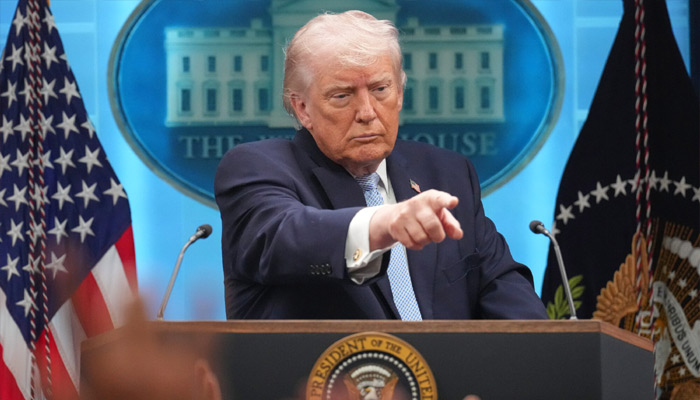
Talks between the United States and Iran began in Islamabad on Saturday after a delay of more than five hours, with Donald Trump striking a cautious note and warning of a possible “reset” if diplomacy fails.
Speaking to US media, Trump confirmed that negotiations were underway but admitted uncertainty over their outcome. “I have no idea” how the talks will unfold, he said, adding that Washington would judge Tehran’s intent “in a very short period of time.”
He also signalled broader strategic stakes, saying the Strait of Hormuz could reopen soon while hinting at alternative global oil routes. Calling Iran a “failing nation,” Trump warned that the US is prepared to shift course if talks break down.
High-stakes meeting after rocky start
The meeting marks one of the most significant engagements between Washington and Tehran in decades.
Senior US officials, including JD Vance, Steve Witkoff and Jared Kushner, met Iranian counterparts led by Mohammad Bagher Qalibaf and Foreign Minister Abbas Araghchi.
According to Pakistani sources, the talks ran for about two hours before being paused. Pakistan’s military leadership was also present, underscoring Islamabad’s central role as mediator.
Earlier, efforts led by Prime Minister Shehbaz Sharif helped bring both sides to the table despite disagreements over preconditions.
Confusion and mistrust cloud talks
Even as discussions got underway, conflicting claims highlighted deep mistrust.
A US official said American naval vessels had moved through the Strait of Hormuz — a critical global energy corridor — but Iranian media and Pakistani officials disputed the assertion. Trump, meanwhile, claimed US forces were securing the route and that Iran’s naval capabilities had been weakened.
Another flashpoint emerged over reports that Washington had agreed to release frozen Iranian funds. While Iranian sources described it as a goodwill gesture, US officials denied any such move, and Qatar — where some funds are reportedly held — did not comment.
Iran’s demands and regional complications
Tehran has entered talks with firm conditions, including guarantees on Hormuz, release of financial assets, compensation for wartime losses, and a broader ceasefire across the region.
A key demand is a halt to hostilities in Lebanon, where fighting involving Hezbollah continues. However, both the US and Israel maintain that the Lebanon conflict is separate from these negotiations.
Iranian officials have signalled a cautious approach. Government spokesperson Fatemeh Mohajerani said Tehran would negotiate “with our finger on the trigger,” reflecting deep scepticism about US intentions.
At the heart of the talks is Iran’s assertion of control over the Strait of Hormuz, including the potential to impose transit fees — a move with far-reaching implications for global energy markets.
Fighting continues in Lebanon
Even as diplomacy unfolds, violence in Lebanon shows no sign of easing.
Israeli strikes and surveillance over Beirut continue, while Hezbollah has responded with attacks on Israeli positions. Parallel discussions involving Israeli and Lebanese officials are expected in Washington, though details remain unclear.
Regional risks and Pakistan’s tightrope
Regional leaders have stressed that any lasting solution must include a broader framework involving key allies.
Bilawal Bhutto Zardari has called for a more inclusive approach, while analysts warn that failure of the talks could escalate tensions across the region.
Pakistan, given its strategic location and ties with Saudi Arabia, faces particular risks. Experts caution that a breakdown in negotiations could draw Islamabad into a wider conflict.
Security in the capital has been tightened significantly, with thousands of personnel deployed as delegations meet under heavy protection.
Fragile path ahead
The talks — the most significant since the fallout of the 2015 nuclear deal — come amid heightened tensions and deep distrust. With both sides holding firm positions, the outcome remains uncertain. While the start of direct engagement signals a possible opening, the risk of escalation looms large if diplomacy fails.
Comments are closed.