
US Launches Strikes on 140 Iranian Targets After Hormuz Closure; Tehran Hits UAE, Qatar

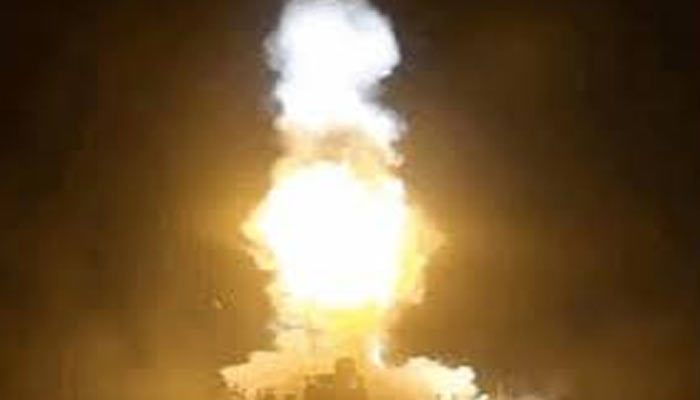
US Strikes 140 Iranian Targets After Hormuz Closure; Tehran Launches Missile Attacks on Gulf States
The conflict in the Middle East escalated sharply on Sunday after the United States carried out a fresh wave of airstrikes on Iran following Tehran’s decision to close the Strait of Hormuz, one of the world’s busiest oil shipping routes. In response, Iran launched missile and drone attacks targeting Bahrain, Kuwait, Qatar and the United Arab Emirates (UAE), raising fears of a wider regional conflict.
Iran Shuts Strait of Hormuz
The escalation began after Iran’s Islamic Revolutionary Guard Corps (IRGC) announced the closure of the Strait of Hormuz “until further notice.”
According to Iranian state media, the decision followed an incident involving a commercial vessel that Tehran claimed had taken an “unauthorised route” through the strategic waterway. The IRGC alleged that several ships ignored instructions to alter course, prompting warning shots and the detention of one vessel.
Iran warned that any military response to the incident would be met with a “severe” retaliation.
US Launches Fresh Airstrikes
Hours after the announcement, the US Central Command (CENTCOM) launched its third round of strikes against Iran in a week.
Washington said the operation was ordered by President Donald Trump after Iran allegedly attacked a Cyprus-flagged container ship transiting the Strait of Hormuz. US officials said the vessel caught fire following the attack, leaving one civilian crew member missing and causing significant damage.
The strikes began at 7:15 pm Washington time and targeted nearly 140 locations across Iran.
According to CENTCOM, the targets included:
- Missile and drone launch sites
- Naval facilities
- Ammunition depots
- Coastal surveillance systems
- Military communication networks
The US said the operation was aimed at reducing Iran’s ability to threaten commercial shipping through the Strait of Hormuz.
US Defence Secretary Pete Hegseth defended the strikes, saying Iran had “made a poor choice” and would now face the consequences.
Explosions Reported Across Southern Iran
Iranian media reported multiple explosions in several southern provinces following the strikes.
Blasts were reported in and around Bushehr, Asalouyeh, Bandar Abbas, Bandar-e Dayyer, and Sirik, all key coastal locations linked to Iran’s energy infrastructure and the Strait of Hormuz.
Iran Retaliates Against Gulf States
Iran responded by launching missiles and drones towards several Gulf countries that host US military facilities.
The UAE said its air defence systems intercepted incoming missiles and unmanned aerial vehicles, while Bahrain activated air raid sirens and urged residents to move to safe locations.
Explosions were also reported in Qatar, which issued missile alerts, while Kuwait’s military said it had intercepted incoming projectiles.
The latest attacks mark another expansion of the conflict, with Gulf states increasingly drawn into the confrontation due to the presence of American military bases on their territory.
Strait of Hormuz Back at the Centre of Crisis
The closure of the Strait of Hormuz has once again emerged as the biggest flashpoint in the conflict. The narrow waterway carries a significant share of the world’s oil and liquefied natural gas exports, making any disruption a major concern for global energy markets.
The latest escalation also casts doubt on diplomatic efforts to end the conflict. Although US President Donald Trump and Iranian President Masoud Pezeshkian had announced a 14-point ceasefire framework in June aimed at ending hostilities, Trump later declared the agreement effectively “over.”
With military operations intensifying and the Strait of Hormuz now closed, fears are growing that the conflict could trigger a broader regional crisis and disrupt global energy supplies.
Comments are closed.