

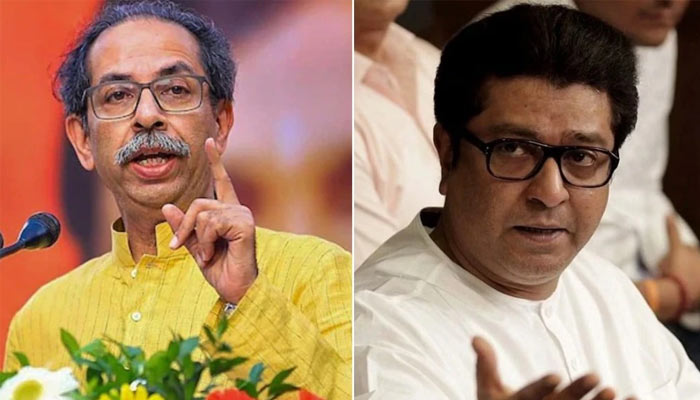
Thackeray Cousins’ Reunion Sparks Alliance Buzz in Mumbai’s Saturday Political Blockbuster.
What was meant to be a “victory rally” over the Maharashtra government’s rollback of the controversial three-language policy transformed into a political spectacle — a high-voltage reunion of estranged cousins Uddhav Thackeray and Raj Thackeray after two decades. The emotional optics and subtle signals from the NSCI Dome in Worli on Saturday have set the stage for what could be a seismic realignment in Maharashtra politics ahead of crucial civic polls.
A Family Reunion with Political Undertones
“Today, after 20 years, Uddhav and I have come together. What Balasaheb could not do, Devendra Fadnavis did… He brought us together,” quipped Raj Thackeray, leader of the Maharashtra Navnirman Sena (MNS), with his trademark irony. His remark drew laughter and applause, but also underlined the growing discontent with the BJP within regional Marathi circles.
Unlike Raj, Uddhav Thackeray — leader of Shiv Sena (UBT) — was unequivocal. “We have come together to stay together. We will together capture power in the Mumbai civic body and Maharashtra,” he declared, galvanizing the crowd of Marathi enthusiasts that had packed the venue.
It wasn’t just the visuals that spoke volumes. The absence of party flags or symbols — no saffron, no bow-and-arrow, no railway engine — signaled something bigger than a party event. It was a Thackeray show, designed to rally the ‘Marathi manoos’ under a broader, possibly united front.
Will They, Won’t They?
While both leaders were careful not to officially announce an alliance, the writing is on the wall. The BMC elections — expected later this year — are critical. For Uddhav, it’s a fight to retain relevance after his Shiv Sena’s split and a lukewarm performance in the 2024 Lok Sabha polls. For Raj, whose party failed to win a single seat in the Assembly, it’s a question of political survival.
And yet, forming an alliance may be easier said than done.
Seat-sharing will be a major challenge. Both the MNS and Shiv Sena (UBT) draw support from overlapping Marathi strongholds in Mumbai, including Worli, Sewri, and Bhandup. In previous elections, they often found themselves pitted against each other in these very constituencies.
Moreover, despite the emotional resonance of their reunion, the MNS’s declining vote share — just 1.6% in 2024 — has raised questions about what Raj really brings to the table, electorally speaking. The BJP has already dismissed the reunion as theatrics, claiming it won’t impact the larger political equation.
A High-Stakes Battle
The stakes couldn’t be higher. The BMC, India’s richest municipal corporation, has been a Shiv Sena bastion for over 25 years. But with the party now divided, and the BJP and Shinde-led faction aggressively eyeing control, a Thackeray-led alliance may be the only way to hold ground.
The 2024 results underscored the uphill climb: Uddhav’s Sena (UBT) secured only 20 seats with 10% of the vote, while the Shinde faction bagged 57 seats at 13%. In direct contests, Shinde’s side beat Uddhav’s in 36 of 50 constituencies.
For both cousins, then, this is more than just a political experiment — it’s a potential last shot at relevance. Raj is 57, Uddhav is 65. If the BJP and Shinde faction sweep the civic polls, the curtain could fall on the Thackeray era as we know it.
What Lies Ahead
The Saturday rally was the opening act. Whether it marks the start of a full-fledged alliance or remains a symbolic reunion depends on how the cousins navigate the minefield of egos, legacy, and ground-level arithmetic. But one thing is clear: the Thackeray brand still evokes emotion and loyalty, especially in Mumbai.
And in a political landscape increasingly driven by pragmatism over ideology, this new script may be worth watching — if not for its outcome, then at least for the drama it promises.
Comments are closed.