

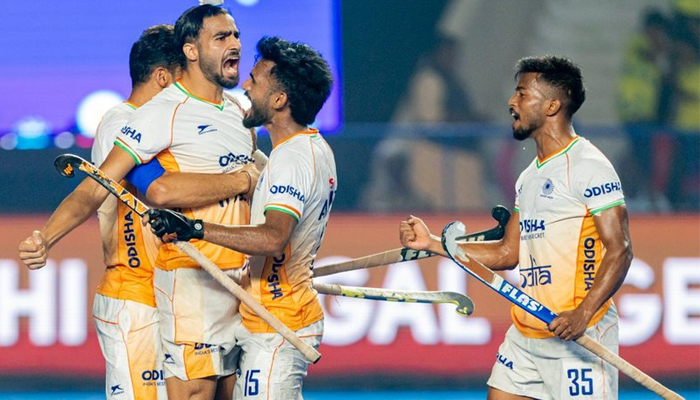
Sometimes, teams chase shadows. For most of the first three quarters, that’s exactly what India did before finally snapping out of it.
Their play from the outside seemed conflicted—stylish in flashes but largely uneven, the pieces of this junior side refusing to click. But when they finally did in the fourth quarter, India didn’t just equalise—they surged past Argentina to clinch what may go down as one of the most significant bronze medals in Indian junior hockey history.
India’s 4–2 win over the two-time world champions (2005 and 2021) wasn’t just a comeback. It hinted at depth, resilience and a pipeline that suggests the transition to the senior team could be smoother than expected.
Argentina, meanwhile, will replay this one for years. Up 2–0 with just 15 minutes left, they stopped pressing and stepped back. Their early, sharp runs through the middle faded. India’s higher press in the third and fourth quarters sowed doubt—Argentina seemed convinced that stepping out would leave them exposed at the back. And that’s exactly what happened. From 0–2 down, India staged a furious 15-minute turnaround, powered by innovative set-piece play. In the past decade, only a handful of Indian teams—mostly seniors in the Pro League—have used indirect penalty-corner deflections to unlock tight games. This young side pulled that off twice under immense pressure.
In close contests where a single moment separates despair from glory, trying a central deflection at 2–2 requires nerve. India showed it—not once but twice—to halve the deficit, equalise, and charge ahead 3–2 before sealing the bronze at 4–2 as Anmol Ekka rifled home India’s seventh PC with Argentina’s goalkeeper off the pitch.
Ekka himself was the subplot that grew into the headline. Barely three minutes in, with fans still settling and VIPs trickling in, he clattered into Nicolás Rodríguez in the circle. South African umpire Annelize Rostron pointed straight to the spot. A costly early error by Ekka handed Argentina the lead and a mental edge that often derails young players. But Ekka clawed back into the match, pushing higher, pressing harder, and finding rhythm by the end of the second quarter.
India struggled in transition early. They rarely isolated defenders or created overloads. Pass-and-stand sequences replaced off-the-ball movement. Space creation was minimal, the channels narrow, and execution resembled their disjointed semifinal against Germany—players clumping together and offering Argentina easy clearances. By halftime, cohesion was missing.
Argentina weren’t exactly dangerous, but they hovered—waiting for deflections, loose balls, and defensive lapses. With India misfiring on their first four PCs, Argentina found their moment in the 44th minute: Federico Hanselmann flicking from the byline to Santiago Fernandez, who spun and smashed it home. At 2–0, India stared at a closing door. With one quarter left, fans wondered if they could at least force a shoot-out.
Fourth quarters change everything. Down two with a medal on the line, subtle tactical shifts can reshape not just a match but legacy. For three quarters, India sputtered like a cold diesel engine. Then, suddenly, all cylinders fired. Argentina wobbled. Their coaches were warned for repeated protests, the technical table visibly irritated.
The 49th minute lit the fuse. Arshdeep was shoved in the circle—PC number five. Ekka flicked, Ankit Pal crouched for the perfect deflection, and India had life at 1–2. The stadium shook awake. Three minutes later, Arshdeep tore down the right, was impeded again—PC six. Ekka flicked once more, Manmeet delivered a carbon-copy central deflection into the roof of the net. 2–2. Argentina were reeling.
By then, the match had abandoned its earlier pattern. In hockey’s four-quarter system, you can lose three mini-battles but still win the war if you dominate the fourth. India embodied that.
Arshdeep, now unstoppable, took a shove from captain Tomás Ruiz with his back to goal—stroke awarded. Sharda Nand Tiwari converted. In eight electrifying minutes, India had flipped a lost cause into a 3–2 lead.
Argentina, exhausted, tried one last push and earned their fifth PC, which India defended with conviction. With time evaporating, Argentina pulled their goalkeeper. Physical tackles crept in—a sign of mental unravelling. Ruiz fouled again, this time far from the circle, yet India earned PC number seven. Ekka stepped up, and his flick sliced between two defenders on the line. 4–2. Game over.
Ekka, after a disastrous start, turned supernova. Arshdeep, shaky for three quarters, became the catalyst—winning two PCs and a stroke. And the team, collectively, displayed the staggering effort that delivers drama, defines tournaments, and leaves lasting imprints.
This bronze was more than a medal—it was a statement of possibility. The pleasure of watching a team build itself lies in nights like these, where a generation discovers what it’s made of.
Comments are closed.