
US Open 2026: Ben Shelton Stuns Carlos Alcaraz in Epic Five-Set Thriller

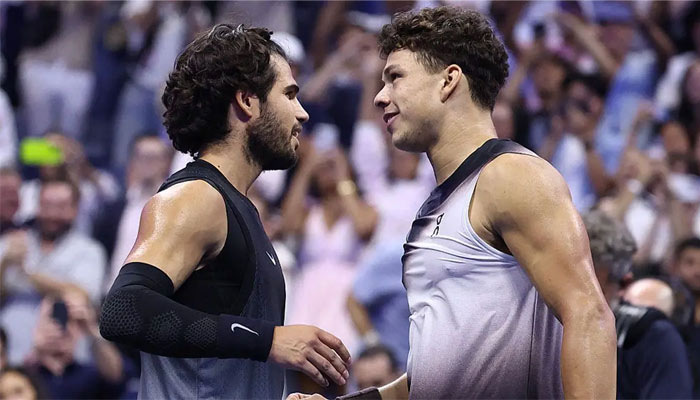
The US Open clash between Ben Shelton and Carlos Alcaraz was never going to be an ordinary tennis match.
It was a four-hour-and-28-minute battle of power, athleticism and nerve that eventually ended at 3:33 in the morning with Shelton producing a 146 mph ace to send the defending champion crashing out.
The intensity was evident from the opening set.
During the first-set tiebreak, Alcaraz appeared to have created the perfect opportunity to finish a point. He sent Shelton racing to one side of the court, but the American somehow reached the ball, recovered his balance and then sprinted back towards the centre before lifting a lob over Alcaraz to keep the rally alive.
The commentary box could only marvel at what had unfolded.
“That is insane. It’s incredible athleticism from both these guys.”
It was an early glimpse of the contest that followed. Neither player was prepared to surrender a point, and almost every exchange carried the feel of a physical confrontation.
Shelton later described the encounter simply as a “war”.
“I’m tired,” he admitted after the match. “That was a war, epic match. I mean, so physical.”
Shelton meets Alcaraz’s power head-on
Unlike some of Alcaraz’s biggest rivals, Shelton did not attempt to outmanoeuvre the Spaniard by changing the rhythm or relying on extended tactical exchanges. He chose a more straightforward approach: attack.
Power was met with power.
Shelton’s serve became his biggest weapon. The American repeatedly pushed towards the 150 mph mark, reaching a top speed of 149 mph. Of his 156 serves, 54 went unreturned. He won 70% of his first-serve points and 57% on his second serve.
There were huge deliveries throughout the match, including 145 mph and 148 mph aces, before the 146 mph serve that finally sealed the victory.
But Shelton’s performance was about more than simply serving big.
He remained aggressive once rallies began, attacked shorter balls and trusted his forehand. He also moved forward effectively, winning eight of nine points at the net in the opening set.
Alcaraz, meanwhile, initially looked in control.
Shelton led 5-3 in the opening-set tiebreak and appeared close to taking the set, only for Alcaraz to respond by winning four consecutive points. Shelton lost the set, but rather than allowing the setback to affect him, he produced his best tennis immediately afterwards.
Shelton turns the match around
The second set marked a major shift.
Shelton became more aggressive on return while Alcaraz’s first-serve percentage fell from 65% in the opening set to just 50%. The American recognised the opportunity and attacked it.
Suddenly, errors began to creep into Alcaraz’s game.
The Spaniard had looked comfortable during the tournament’s opening rounds after returning from a four-and-a-half-month competitive absence caused by a right wrist injury. Against Shelton, however, the relentless pace presented a completely different challenge.
Alcaraz’s timing occasionally appeared slightly off. Shots that would normally find the corners went into the net, while others landed shorter than usual.
By the end of the second set, the contrast was stark: Alcaraz had made 32 unforced errors compared with just 13 from Shelton.
Shelton won the set 6-1.
He then carried that momentum into the third, winning nine consecutive games across the second and third sets. He raced to a 3-0 lead and continued forcing Alcaraz to deal with extraordinary pace.
For stretches, the question was no longer whether Alcaraz could hurt Shelton, but whether he could consistently withstand the American’s level of aggression.
Alcaraz refuses to surrender
Yet writing off Alcaraz has rarely been a wise decision.
The fourth set produced another dramatic turnaround.
Alcaraz broke Shelton early, began taking the ball with greater conviction and pushed the American deeper behind the baseline. The frustration that had dominated his body language earlier disappeared, replaced by the confidence that has defined his rise to the top of men’s tennis.
This time, it was Alcaraz who dominated.
He won the fourth set 6-1, taking the match into a deciding fifth set.
One final battle
The decider became a test of composure.
Neither player could find a breakthrough. Shelton created break-point opportunities at 4-4, but Alcaraz managed to escape. Shelton’s serve, which had been crucial throughout the night, once again held firm when the pressure intensified.
A fifth-set tiebreak was inevitable.
Shelton made the first move, taking a 3-1 lead after an early mini-break. But Alcaraz immediately fought back and moved ahead 5-3.
At 6-6, the match had been reduced to its simplest equation: who could deliver one decisive blow?
Shelton did.
He moved to 8-6 before unleashing the serve that ended the marathon. The 146 mph delivery was simply too much for Alcaraz to handle.
After more than four hours, Shelton had finally completed one of the biggest wins of his career.
The numbers behind Shelton’s victory
The statistics showed just how close the contest was.
Shelton hit 34 winners, while Alcaraz produced 38. Alcaraz had the edge in longer rallies, but Shelton was far more efficient in the shorter exchanges.
The American committed 35 unforced errors compared with 53 from Alcaraz and won 55% of rallies lasting four shots or fewer.
Those small margins proved decisive.
It would be easy to attribute Alcaraz’s defeat entirely to his long competitive layoff. He had not played since April and acknowledged that he began to feel physically tired after the third set.
But that explanation alone does not capture what happened.
Alcaraz still fought back from two sets to one down, won the fourth set convincingly and pushed Shelton all the way in the decider. The Spaniard had enough left to make the final set a genuine toss-up.
The difference was Shelton’s serve.
Alcaraz himself recognised how important the weapon had become in the biggest moments. Every time Shelton stepped to the line, there was the possibility that the point might disappear instantly behind another ace or unreturnable delivery.
There was no sense of an excuse from Alcaraz. Instead, there was an acknowledgement that Shelton had earned the advantage.
A victory built on courage and aggression
This was not a match Alcaraz simply lost because he played poorly.
Shelton beat him by embracing the same high-risk tennis that makes Alcaraz so dangerous. He saw the power coming from the opposite side of the net and chose to attack it rather than retreat.
The match had everything: explosive serving, brutal forehands, spectacular recoveries, frantic rallies and a crowd that remained engaged despite the extraordinary late hour.
That opening tiebreak point captured the entire contest in miniature — Shelton stretching desperately, recovering his balance, sprinting back into position and somehow producing the lob.
Four hours later, after the momentum swings, errors, nine-game Shelton run, Alcaraz comeback and final 146 mph ace, the commentary-box verdict still felt appropriate.
It was insane.
It was physical.
And above all, it was a war that Ben Shelton won.
Comments are closed.