
Tamil Nadu Stands Firm on Two-Language Policy After SC Urges ‘Mindset Change’ on Hindi

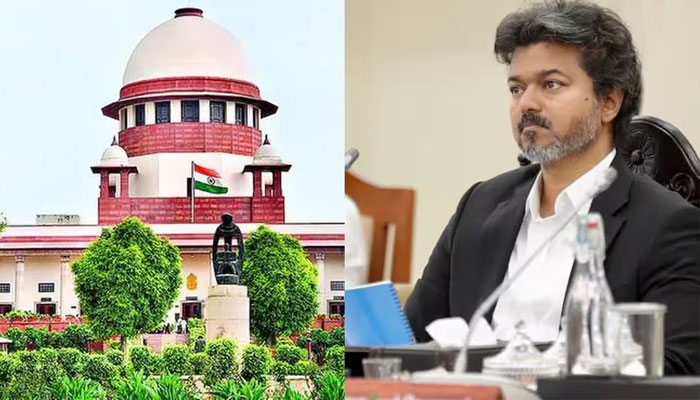
Tamil Nadu has reiterated that it will continue with its two-language policy and will not allot land for Jawahar Navodaya Vidyalayas, despite recent observations by the Supreme Court urging the state to reconsider its stand on Hindi.
School Education Minister and TVK leader Rajmohan Arumugam said the state government remained committed to its existing language policy. He maintained that Tamil Nadu was not opposed to Hindi or any other language but wanted to ensure that Tamil continued to receive priority in the state.
According to Rajmohan, the Supreme Court’s comments were made during the hearing and should not be treated as a final ruling. He also pointed out that the state has been experimenting with bilingual education in its model schools while continuing to oppose the allocation of land for CBSE institutions under the present framework.
“The bilingual policy has existed in Tamil Nadu for years and continues to remain in place,” Rajmohan said, adding that the state’s position was aimed at protecting the importance of Tamil rather than opposing any particular language.
The issue has also brought the ruling TVK and opposition DMK closer on the language question. Leader of the Opposition and DMK leader Udhayanidhi Stalin has supported the government’s decision to maintain the two-language policy. He said the state could consider convening a special session of the Assembly, if required, to adopt a resolution opposing the establishment of centrally sponsored Navodaya schools.
Why Are Navodaya Schools at the Heart of the Dispute?
Jawahar Navodaya Vidyalayas are centrally funded, co-educational residential schools administered by the Navodaya Vidyalaya Samiti under the Union Ministry of Education. They were created to provide quality education, particularly to talented students from rural and economically disadvantaged backgrounds.
The schools operate under a three-language framework, with Hindi playing a role in their language structure. The Centre has sought to establish Navodaya schools in Tamil Nadu as part of its nationwide network.
Tamil Nadu, however, has opposed the proposal because it follows a long-standing two-language policy based on Tamil and English. The state’s resistance is also linked to the wider political and cultural debate over the role of Hindi in education.
The immediate disagreement is not limited to language policy. A key issue is the allocation of land.
Tamil Nadu has declined to provide land to the Navodaya Vidyalaya Samiti, arguing that it should not be required to facilitate a Central education programme whose language structure does not conform to the state’s education policy.
During the proceedings, the state also raised concerns relating to its policy-making authority and cooperative federalism. Its argument has been that Navodaya schools are a Central initiative and that the state should not be compelled to assist in implementing a scheme that conflicts with its established policy.
The Centre has maintained that Tamil Nadu should identify appropriate land for the schools, while the Union government would bear the expenses associated with their establishment.
The Supreme Court has now granted Tamil Nadu another three months to comply with its earlier direction to identify suitable land for Navodaya schools in every district.
What Has the Supreme Court Said?
The latest observations were made while the Supreme Court was hearing Tamil Nadu’s challenge concerning directions for establishing Navodaya schools in the state.
The Bench questioned Tamil Nadu’s opposition to Hindi in the context of the proposed schools. Justice BV Nagarathna urged the state to “change its mindset” and said it could not maintain that Hindi would not be taught on Tamil Nadu’s soil.
The court also questioned the state’s opposition to an additional set of schools, observing that Navodaya institutions could provide students with another educational option without requiring the state to discontinue or modify its existing schools.
However, the observations made during the hearing do not by themselves amount to a final determination of the broader language-policy dispute. This is the point emphasised by Rajmohan in defending the government’s position.
The court has also encouraged the Centre and Tamil Nadu to continue discussions and attempt to resolve the disagreement through the principles of cooperative federalism.
For now, the three-month extension means the dispute over land and the proposed Navodaya schools remains before the court.
Navodaya Issue Creates Unusual Political Unity
The dispute has also resulted in an uncommon moment of agreement between Tamil Nadu’s ruling party and the opposition.
TVK chief and Chief Minister C Joseph Vijay and DMK leader Udhayanidhi Stalin have been political rivals since the emergence of the TVK as a significant force in state politics. Their parties have frequently taken opposing positions on various political issues.
On the Navodaya issue, however, the two sides have adopted similar positions.
Udhayanidhi has backed the government’s decision to continue with the two-language policy and argued that Tamil Nadu already has model and residential schools capable of providing quality education to students from disadvantaged sections.
He has also urged the state government to continue presenting its arguments before the Supreme Court and suggested that a special Assembly session could be held, if necessary, to reiterate Tamil Nadu’s opposition to Navodaya schools.
On Hindi, Udhayanidhi has similarly maintained that the state’s position should not be interpreted as opposition to the language itself. His argument is that Tamil Nadu is resisting compulsory language imposition while retaining its own education and language framework.
The Navodaya controversy has therefore expanded beyond a dispute over the establishment of schools. It now involves questions of language policy, state autonomy, education administration and Centre-state relations, while also producing an unusual area of agreement between Tamil Nadu’s ruling and opposition parties.
Comments are closed.