
Trump Removes Susie Wiles After Midterm Setback, Names Stephen Miller as New Chief of Staff

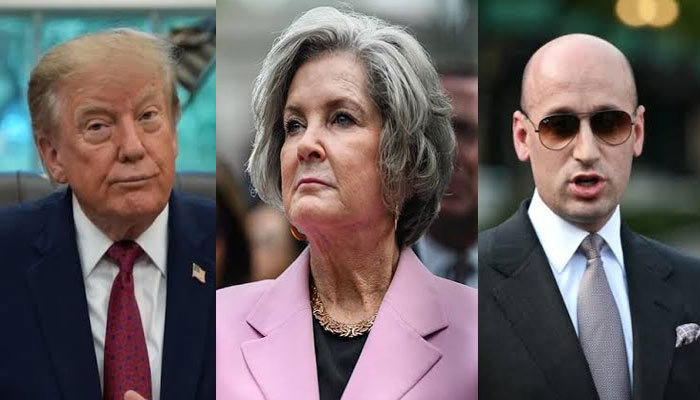
Trump Replaces Susie Wiles With Stephen Miller as White House Faces Political Fallout From Midterm Results
US President Donald Trump has reportedly decided to replace White House Chief of Staff Susie Wiles with longtime adviser Stephen Miller following a major setback for Republicans in the midterm elections. The reported leadership change comes amid growing political uncertainty and questions over the administration’s strategy for the remainder of Trump’s second term.
According to the supplied report, Trump announced the decision through his social media platform, Truth Social, on Friday. He praised Wiles for her contribution to the administration and confirmed Miller’s appointment to the influential position.
Wiles made history as the first woman to serve as White House chief of staff. Although she is reportedly stepping down from the position, Trump indicated that she would continue working with his political organisation.
Miller, who has served as deputy chief of staff, has been one of Trump’s most influential advisers. He has played a significant role in developing the administration’s immigration policies, particularly its approach to border security, deportations and national security.
REPUBLICANS FACE POLITICAL SETBACK AFTER MIDTERM ELECTIONS
The reported reshuffle follows the November 3 midterm elections, in which Democrats are said to have made substantial gains, challenging Republican control of both chambers of Congress.
The electoral setback is attributed to several issues, including concerns about the cost of living, the economic consequences of tariffs and public opposition to the US military involvement in Iran.
The supplied report also highlights significant political developments in traditionally Republican-leaning states. These include a Democratic victory in Kansas and the defeat of Trump’s preferred Senate candidate in South Carolina.
A change in congressional control would have significant implications for the administration. Democrats could exercise greater oversight through congressional committees, launch investigations and make it more difficult for Trump to advance his legislative priorities during the remaining two years of his presidency.
WHO ARE STEPHEN MILLER AND SUSIE WILES?
Stephen Miller has been associated with Trump’s political movement since the 2016 presidential campaign, when he worked as a speechwriter. Over the years, he has become a central figure in the President’s inner circle, particularly on immigration and border enforcement.
Susie Wiles, meanwhile, earned recognition for managing Trump’s political operations and campaign organisation. She was involved in his 2016 campaign, managed his Florida operations in 2020 and played a leading role in his successful 2024 presidential campaign.
She took charge as White House chief of staff at the beginning of Trump’s second term. Her tenure followed a turbulent first presidency, during which Trump had four different chiefs of staff.
Her reported departure also comes after she disclosed an early-stage breast cancer diagnosis in March 2026. Following surgery and treatment, she announced in September that there was no longer evidence of the disease.
In her reported response to Trump’s announcement, Wiles described her White House service as the honour of a lifetime and reiterated her support for the President.
JUSTICE DEPARTMENT SEES MORE SENIOR DEPARTURES
Separately, the US Department of Justice has reportedly witnessed additional leadership changes following the Republican electoral setback.
John Eisenberg, who headed the department’s National Security Division, and Jason Reding Quiñones, the former US attorney for the Southern District of Florida, are among the officials reported to have resigned. Their departures followed Harmeet Dhillon’s exit as head of the Civil Rights Division.
The latest developments could affect two significant areas of the administration’s legal agenda: reviewing previous investigations involving Trump and pursuing legal action against higher education institutions.
The reasons behind the resignations have not been clearly established. However, the departures come at a politically sensitive moment, with Democrats expected to increase scrutiny of the administration and its activities.
QUIÑONES AND INVESTIGATIONS INVOLVING TRUMP’S POLITICAL OPPONENTS
During his tenure, Quiñones was associated with efforts to revisit investigations involving Trump’s political adversaries and earlier federal probes concerning the President.
His office examined matters relating to the investigation into Trump’s handling of classified documents after leaving office in 2021, as well as allegations concerning contacts between his 2016 campaign and Russia.
The investigation sought to examine claims that Trump had been subjected to a prolonged criminal conspiracy. However, the supplied report states that the inquiry has not resulted in criminal charges.
His tenure in Miami also witnessed considerable changes in the prosecutorial workforce. Several prosecutors reportedly left the office, while others associated with investigations into the January 6, 2021, Capitol attack were dismissed.
The office was also involved in the administration’s legal actions concerning Cuba and Venezuela, including proceedings against former Cuban President Raul Castro and Venezuelan government associate Alex Saab.
EISENBERG’S DIVISION FACED CONTROVERSY
John Eisenberg maintained a relatively low public profile, but the National Security Division under his leadership was involved in several contentious Justice Department operations.
These included a search of a Washington Post reporter’s residence during an investigation into classified information leaks. The division also participated in proceedings concerning the deportation of an Afghan lawful permanent resident who had not been charged with a crime.
Another significant responsibility involved reviewing and redacting millions of documents connected to convicted sex offender Jeffrey Epstein before their public release.
The extent of the redactions attracted criticism from lawmakers across party lines, with questions raised about the amount of information withheld from the public.
The reported departures of senior Justice Department officials, combined with the proposed White House leadership change, point to a period of organisational uncertainty for the Trump administration as it faces the prospect of increased congressional oversight.
Comments are closed.