
‘Catastrophic’: Swiss Glaciers Lose a Fifth of Their Ice Mass in Just Five Years

Swiss glaciers lose nearly 20% of mass in five years as 2026 records second-worst melt
Switzerland’s glaciers have lost nearly one-fifth of their ice mass in just five years, with 2026 marking the second-largest annual melt on record, according to the Glacier Monitoring in Switzerland (GLAMOS) network.
Swiss glaciers lost 5.5% of their volume this year, following a winter with limited snowfall and an exceptionally hot summer. GLAMOS chief Matthias Huss described the year as “a catastrophic year” for the country’s glaciers.
“The glaciers this year have lost enormous quantities of ice,” Huss said.
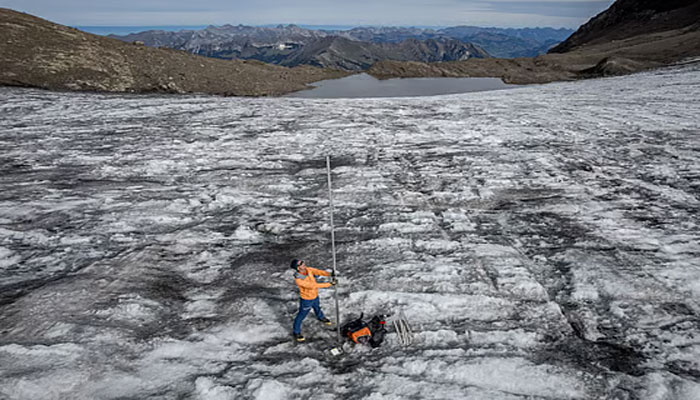
At the Scex Rouge glacier, nearly 3,000 metres above sea level, Huss pointed to the rapid retreat of the ice. A four-metre aluminium measurement stake installed in late July was initially almost completely buried. By September, more than three metres of it was exposed.
“This is a glacier that isn’t surviving,” Huss said, adding that there could be no ice left there within 10 to 15 years.
Glacier melt accelerating rapidly
The GLAMOS report found that the rate of ice loss between 2022 and 2026 was more than twice as high as during any previous five-year period of monitoring. Switzerland’s glaciers have lost almost 20% of their volume since 2021.
The long-term trend is also accelerating. While the country lost about 10% of its glacier ice between 1990 and 2000, losses reached 27% over the past decade, the report said.
The findings are based on detailed measurements from 23 reference glaciers taken in September. Researchers used those results to estimate changes across Switzerland’s nearly 1,300 remaining glaciers.
Record heat strips protective snow cover
The latest losses followed an exceptionally warm summer. June, July and August were each the hottest such months recorded in Switzerland since measurements began in 1864, according to the Swiss Federal Office of Meteorology and Climatology.
The protective snow cover on glaciers had already been reduced during June’s heatwaves and had disappeared completely by September, including at high elevations, GLAMOS said.
“Alpine glaciers have no chance of surviving in the long term under such conditions,” the monitoring network said.
Some glaciers lost between 2.5 and 4 metres of average ice thickness, while exposed glacier tongues lost as much as 10 metres over the summer.
Rhone, Aletsch among glaciers hit by record melt
Despite the severe losses, 2026 did not break the overall annual record set in 2022. Researchers said several glaciers had received more snowfall before the summer melt this year than they did four years ago.
Lower levels of Sahara dust also helped reflect more sunlight away from the ice, reducing the amount of energy absorbed by the snow and glacier surface.
However, four major glaciers recorded their highest-ever annual melt, including the Rhone Glacier and Aletsch Glacier, the largest glacier in the Alps.
Glacier retreat raises water concerns
The rapid retreat is also raising concerns about Switzerland’s future water resources.
Between July and September alone, Swiss glaciers lost an estimated 2.2 trillion litres of water.
Huss said the scale of the loss was difficult to comprehend, noting that it amounted to more than four times the annual freshwater consumption of Swiss households.
The continuing decline of the glaciers could have long-term implications for water availability in the Alpine region as the ice reserves that feed rivers and reservoirs continue to shrink.
Comments are closed.