
Nitesh’s Silver Keeps India Waiting for a Greco-Roman Champion at Asian Games

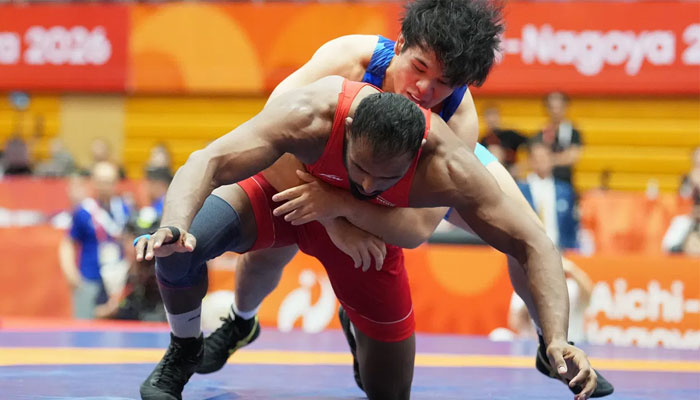
Nitesh Siwach came within one victory of ending India’s long wait for an Asian Games Greco-Roman wrestling gold, but had to settle for silver after losing 0-4 to Japan’s Yuri Nakazato in the men’s 97kg final on Thursday.
Nitesh had stormed into the final with two dominant wins earlier in the day, putting himself on the brink of history. But Nakazato’s defence proved too difficult to breach as the Japanese wrestler controlled the bout and capitalised on his opportunities.
The silver nevertheless marked a significant achievement for Nitesh and Indian Greco-Roman wrestling. India’s last Asian Games gold medals in the discipline came in 1962, when Malwa Singh won the 52kg title and Ganpat Andalkar claimed gold in the +97kg category.
NAKAZATO DENIES NITESH
Nitesh began the final looking to establish a two-on-one grip, but Nakazato immediately worked to deny him an attacking position.
The Japanese wrestler opened the scoring by pushing Nitesh out before the Indian was placed in the ground position for passivity. Nakazato had another opportunity to extend his lead, but Nitesh defended well and prevented him from securing the grip needed for a gut wrench.
Nitesh, however, struggled to create an attacking opportunity of his own, allowing Nakazato to take a 2-0 lead into the break.
The Japanese wrestler continued to frustrate Nitesh after the restart. A push disbalanced the Indian, and Nakazato converted the opening into a takedown to make it 4-0.
With time running out, Nitesh was forced to attack, but Nakazato’s defence held firm. The Japanese wrestler saw out the contest to claim gold and leave Nitesh with silver.
The result extended India’s wait for a Greco-Roman Asian Games champion. Nitesh’s medal was still a notable achievement in a discipline where India had won only four bronze medals at the Games before his campaign.
‘I DID IT FOR HIM’
Nitesh said the medal was particularly special because of his father’s role in his wrestling journey.
“Honestly, I still can’t believe it, I have won a silver medal at the Asian Games. My father always told me there was no looking back once I started this journey, that I had to bring home a medal, and today, I did it for him.”
He also spoke about the pressure of competing in a weight category that had never previously produced an Indian Asian Games medal.
“No one from my weight category had ever won a medal here before, so there was a lot of pressure, but I trusted my training and gave everything I had.”
Acknowledging the support he received during his preparation, Nitesh added: “Maine apne desh ka Tiranga lehra diya. (I have proudly raised my country’s Tricolour.)”
DOMINANT ROUTE TO THE FINAL
Nitesh entered the competition directly in the quarterfinals and defeated Turkmenistan’s Amanberdi Agamammedov 7-1.
He was even more convincing in the semifinal against Mongolia’s Gankhuyang Ganbaatar, winning 9-0 by technical superiority inside the opening three minutes.
Nitesh produced two four-point throws from the ground position to take complete control and book his place in the final.
The victory guaranteed India its best-ever Asian Games finish in the 97kg category and left Nitesh one win away from a historic gold.
Nakazato, however, proved too strong in the final.
MANSI’S BRONZE BID FALLS SHORT
Mansi Ahlawat also remained in medal contention in the women’s 62kg category but finished outside the podium.
She opened her campaign with a 6-1 win over Kazakhstan’s Irina Kuznetsova before defeating South Korea’s Jo Su-been in the quarterfinals.
In the semifinal, Mansi faced Japan’s Asian champion Nonoka Ozaki. The Japanese wrestler took a 2-0 lead with a right-leg attack and added another takedown after attacking Mansi’s left leg.
Mansi attempted a headlock but could not convert it into points, while Ozaki’s defence prevented the Indian from making a comeback. Ozaki won 6-0 to send Mansi into the bronze-medal bout.
Against Mongolia’s Altjin Togtokh, Mansi conceded two early points. She fought back in the second period, earning one point after Togtokh was penalised for passivity and adding another soon after.
Togtokh responded with a takedown to restore her lead. India challenged the decision, but the challenge was unsuccessful.
Mansi continued to attack but could not close the gap and missed out on a medal.
AMAN’S COMEBACK ENDS IN QUARTERS
Aman Baroniya’s campaign in the men’s 77kg category ended in the quarterfinals, despite producing an impressive comeback in the previous round.
Trailing Mongolia’s Borgil Tuvshinbaatar 6-2, Aman turned the bout around with a takedown and a spectacular jumping move that produced another takedown. He completed the comeback with a roll to win 8-6.
His quarterfinal against Qatar’s Shahin Badaghimofrad was a tougher affair. Shahin pushed Aman out twice to take a 2-0 lead before forcing him into the ground position and taking control.
The Qatari eventually won by technical superiority. His failure to reach the final subsequently ended Aman’s hopes of entering the repechage.
SUMIT’S CAMPAIGN ALSO ENDS
Sumit was eliminated in the men’s 60kg quarterfinals after losing 1-1 on criteria to Iran’s Sajjad Abbaspourragani.
His medal hopes depended on Abbaspourragani reaching the final and opening a repechage route. The Iranian subsequently lost his semifinal, ending Sumit’s campaign.
For India, the day ultimately belonged to Nitesh. His run to the final and silver medal represented a significant result for the country’s Greco-Roman programme.
The gold, however, remains elusive. More than six decades after Malwa Singh and Ganpat Andalkar triumphed in Jakarta, India will have to wait again for its next Asian Games Greco-Roman champion.
Comments are closed.