

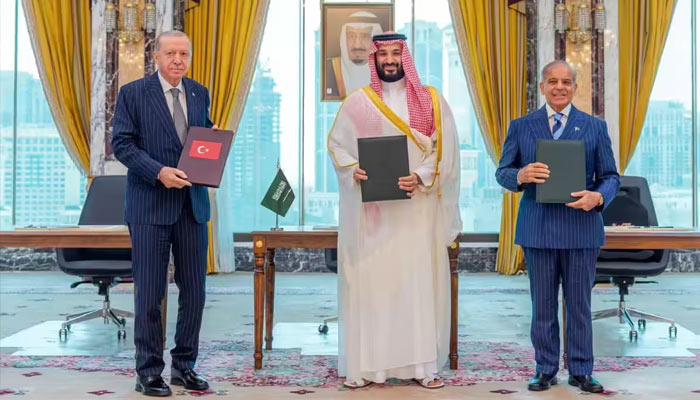
Pakistan-Saudi-Turkey Defense Pact: A New Regional Security Alliance?
A new defense pact between Saudi Arabia, Turkey and Pakistan is being viewed as a major shift in the Middle East’s security landscape, with analysts describing it as an effort to deter Iran, reduce dependence on the United States and send a political message to Israel.
Signed in Mecca, the agreement includes a NATO-style provision under which an attack on one member would be treated as an attack on all three. However, analysts say the clause is unlikely to automatically trigger military action, particularly as Pakistan and Turkey seek diplomatic solutions to the ongoing regional conflict.
Why the pact matters now
The agreement comes as the Middle East war continues to reshape regional security calculations.
The United States has struggled to prevent all Iranian and Iran-linked drone and missile attacks, while disruptions around the Strait of Hormuz and attacks affecting Red Sea shipping have highlighted vulnerabilities in the region’s security infrastructure.
The developments have prompted regional powers to reconsider their reliance on U.S. military protection.
Political analyst Ali Shihabi said the situation demonstrates that American deterrence has weakened and that regional countries may increasingly have to manage the Iranian threat themselves.
Saudi Arabia has also strengthened relations with Turkey and Pakistan, while working with other regional powers on diplomatic efforts to end the conflict.
What does each country gain?
The three countries bring different strengths to the partnership.
Saudi Arabia has enormous financial resources but comparatively limited domestic defense-industrial capacity. Turkey has advanced military technology and a growing defense-manufacturing sector, while Pakistan brings a large military, extensive defense experience and nuclear deterrence.
Analysts say Turkey needs investment and markets, while Pakistan needs financing and industrial opportunities. Saudi Arabia, meanwhile, benefits from expanding its security options beyond reliance on a single U.S. security umbrella.
The pact therefore offers each country a different strategic advantage, although analysts stress that it cannot replace the United States as the region’s dominant security partner.
Will Turkey or Pakistan fight Iran?
Despite the agreement, analysts largely doubt that Turkey or Pakistan would go to war with Iran if Saudi Arabia were attacked.
Both countries have strong reasons to avoid a direct confrontation with Tehran and have positioned themselves as potential mediators in the regional conflict.
Analyst Asli Aydintasbas said Turkey and Pakistan are more likely to act as stabilizing powers and push for diplomacy rather than military escalation.
Still, the agreement carries significant political weight. H.A. Hellyer of the Royal United Services Institute said the pact sends a symbolic message to both Iran and Israel, even if its collective-defense provision is never activated.
Is a new regional security bloc emerging?
The agreement could mark the beginning of a broader regional security arrangement centered on Saudi Arabia, Turkey and Pakistan.
Saudi Arabia has moved closer to both countries as divisions within the Gulf have complicated efforts to build a unified regional security structure.
The pact could also create unease in the United Arab Emirates, which has maintained close security ties with Washington and normalized relations with Israel under the Abraham Accords.
For the United States, the development presents a different vision of regional security. Washington has long promoted an architecture that would bring Israel and Arab states closer together, including through Saudi-Israeli normalization.
Saudi Arabia, however, has continued to insist that it will not establish diplomatic relations with Israel without a credible path toward Palestinian statehood.
Pakistan and Turkey have also taken strongly critical positions toward Israel during the conflict.
As a result, the new defense pact could represent more than a military agreement: it may signal the emergence of a regional security architecture in which Middle Eastern powers seek greater strategic autonomy while continuing to maintain important ties with Washington.
Comments are closed.