
PBKS vs MI, IPL Play of the Day: Captain Jasprit Bumrah’s Mid-Off Masterstroke Steals the Spotlight

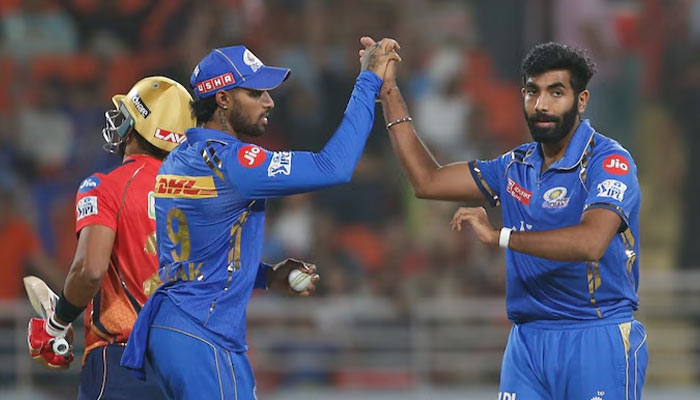
In the age of Impact Players and 200-plus totals, conventional wisdom says bowling captains are a luxury IPL teams can no longer afford.
Batters dominate, margins are microscopic, and captains are expected to think three overs ahead while surviving the chaos of modern T20 cricket. Yet on a cool Dharamsala evening, Jasprit Bumrah quietly made a case for why a bowler might still be the sharpest mind on the field.
With Hardik Pandya unavailable and Suryakumar Yadav absent for personal reasons, Mumbai Indians handed the captaincy to Bumrah for the first time in his IPL career during their clash against Punjab Kings. He did not produce a spell for the highlight reels. There were no yorkers smashing stumps or fiery celebrations after wickets. Instead, Bumrah’s influence spread across the field in quieter, more decisive ways.
The HPCA pitch offered enough unpredictability to reward discipline. Bumrah recognized it immediately. He chose to bowl first, trusting the surface would become easier for batting later in the evening. More importantly, he urged his bowlers to stick to hard lengths and use cross-seam deliveries rather than chasing magic balls. It was a simple plan, but in T20 cricket, simplicity under pressure is often the hardest thing to execute.
His fingerprints were visible throughout the innings. Deepak Chahar dismissed Priyansh Arya with a cleverly angled delivery from around the wicket during the powerplay, a setup clearly discussed beforehand. Shardul Thakur, returning to the XI, thrived under Bumrah’s constant guidance from mid-off. The conversations between overs turned into wickets as Shardul used cross-seam deliveries effectively to dismiss both Prabhsimran Singh and Shreyas Iyer.
Then came young Raj Angad Bawa, who bounced back from a difficult outing earlier in the season. Bumrah stayed close to him throughout the spell, helping him read the conditions ball by ball. The reward arrived when Bawa bowled Cooper Connolly with a delivery that gripped just enough off the surface to sneak through the gate.
That was the striking part about Bumrah’s captaincy. He was not directing traffic from afar. He was living every over with his bowlers, understanding the uncertainty that comes with defending totals in modern T20 cricket. As Shardul later admitted, the game kept swinging wildly, forcing bowlers to constantly rethink whether they were defending, attacking, or simply surviving. Bumrah seemed to anticipate those shifts before they arrived.
Former Australia captain Michael Clarke summed it up neatly by calling Bumrah “aggressive” and “tactically very good.” It was praise earned not through wickets, but through control, calmness, and the ability to make bowlers feel supported in moments where T20 cricket often leaves them isolated.
Punjab Kings eventually crossed 200 after a late surge, but Mumbai Indians chased it down thanks largely to Tilak Varma’s explosive unbeaten knock. Even so, the defining image of the night was not a batter clearing the ropes. It was Bumrah standing at mid-off, talking quietly to his bowlers, adjusting fields, reading the surface, and shaping the game without needing the scoreboard to advertise his influence.
For years, discussions around Bumrah have centered on his yorkers, economy rate, and ability to win matches with the ball. Dharamsala offered a glimpse of something else — a leader capable of reading pressure situations as naturally as he reads seam movement. Mumbai Indians may have stumbled upon that realization late, but on Thursday night, it was impossible to ignore.
Comments are closed.