
Sensex Sheds 500 Points, Nifty Slips Below 22,400 as IT Stocks Drag Markets

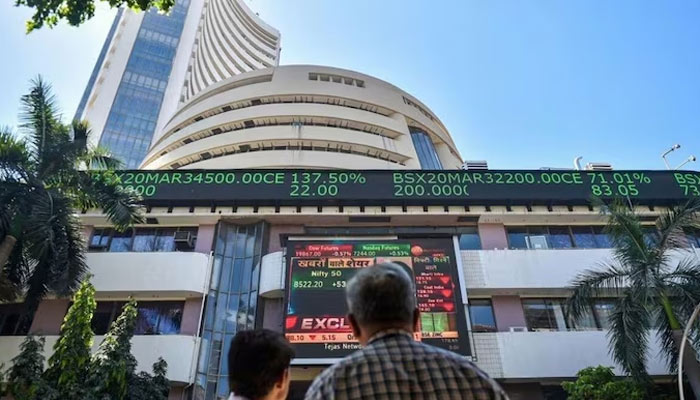
Sensex Plunges Over 500 Points, Nifty Slips Below 22,400 as IT Stocks, High Crude Prices Rattle Markets
Indian equity markets opened lower on Monday, extending the previous week’s losses as elevated crude oil prices, inflationary concerns and weakness in information technology stocks dampened investor confidence. Caution ahead of the US Federal Reserve’s monetary policy announcement later this week further weighed on sentiment.
The BSE Sensex was trading at 72,584.94 at 9:24 am, down 538.89 points, or 0.74%. The index opened at 72,990.04 before declining to an intraday low of 72,549.76.
The NSE Nifty 50 also came under pressure, falling 211.80 points, or 0.94%, to 22,388.20. The index began the session at 22,524.40 and slipped to a low of 22,387.45.
Crude Oil Prices Keep Investors on Edge
High crude oil prices remained a significant concern for investors, even as international benchmarks retreated from their recent peaks. Brent crude futures declined 2.07% to $114.30 per barrel, while US West Texas Intermediate crude fell 2.25% to $100.95.
Despite the decline, oil prices remain elevated, raising concerns about India’s import expenditure, domestic inflation and pressure on corporate profit margins. Persistent geopolitical tensions in the Middle East have also kept the possibility of supply disruptions firmly in focus.
Market participants are meanwhile awaiting the US Federal Reserve’s policy decision later this week. The central bank’s guidance on interest rates could influence global financial markets, capital flows and investor appetite for risk.
IT Shares Lead the Market Decline
Information technology stocks emerged as a major drag on the benchmark indices. The Nifty IT index declined 1.16%, with Infosys falling 1.95% and HCL Technologies losing 1.14%. Tech Mahindra dropped 0.88%, while Tata Consultancy Services slipped 0.54%.
Infosys shares faced selling pressure after the company lowered its annual revenue growth outlook. Weakness in its key North American market outweighed revenue performance that had exceeded expectations.
The weakness extended across most sectors, with 15 of the 16 major sectoral indices trading in negative territory. The Nifty Auto index declined 1.41%, while the FMCG index fell 1.48%. The Nifty PSU Bank index dropped 1.59%, the Nifty Realty index shed 1.26%, and the Nifty Financial Services 25/50 index slipped 1.11%.
Pharmaceutical and healthcare stocks bucked the broader trend. The Nifty Pharma index advanced 0.36%, while the Nifty Healthcare index gained 0.31%, offering limited support amid widespread selling.
Midcap and Smallcap Stocks Also Under Pressure
The downturn was not restricted to large-cap shares, as broader market indices also registered significant losses. The Nifty 100 fell 0.95%, the Nifty 200 declined 1%, and the Nifty 500 dropped 1.07%.
Midcap and smallcap stocks witnessed even greater pressure. The Nifty Midcap 50 declined 1.19%, the Nifty Midcap 100 slipped 1.22%, and the Nifty Smallcap 100 lost 1.66%.
Meanwhile, the India VIX, which measures expected market volatility, climbed 6.45% to 17.95, reflecting heightened uncertainty and increased investor nervousness.
High Crude Prices Could Limit Market Recovery
Dr V K Vijayakumar, Chief Investment Strategist at Geojit Investments Limited, said elevated crude oil prices continued to pose a major obstacle to a sustained market recovery, despite Brent crude easing below $115 per barrel.
He noted that oil prices remained sufficiently high to restrict any significant rebound from the Nifty’s recent lows around 22,600, which the index touched last Friday. Rather than focusing on short-term index movements, he advised investors to look for attractive valuations created by the ongoing correction while remaining mindful of the broader economic risks associated with expensive crude oil.
Vijayakumar also highlighted the correction in midcap and smallcap shares, attributing the recent decline partly to stretched valuations and forced selling of positions financed through borrowed funds.
According to him, although the broader market continues to appear overvalued, the correction could gradually create opportunities in high-growth segments.
He further suggested that a weakening of the global artificial intelligence investment trade could potentially benefit India. He pointed to foreign portfolio investor outflows from South Korea and Taiwan during September and October so far, which had exceeded those from India.
What Investors Will Watch Next
Market direction in the coming sessions is likely to depend on movements in crude oil prices, developments in the Middle East and the US Federal Reserve’s policy announcement.
A sustained decline in oil prices could ease concerns over India’s inflation outlook and import bill. However, persistent geopolitical risks and uncertainty surrounding global interest rates may continue to weigh on investor sentiment.
Investors will also monitor corporate earnings, valuations and foreign investment flows to assess whether the recent correction creates opportunities for fresh buying. For now, elevated oil prices and weakness in IT stocks remain key challenges for the domestic market.
Comments are closed.