
‘Sreejesh Was Disrespected’: Former India Captain Jude Felix Slams Hockey India Over Treatment of P. R. Sreejesh

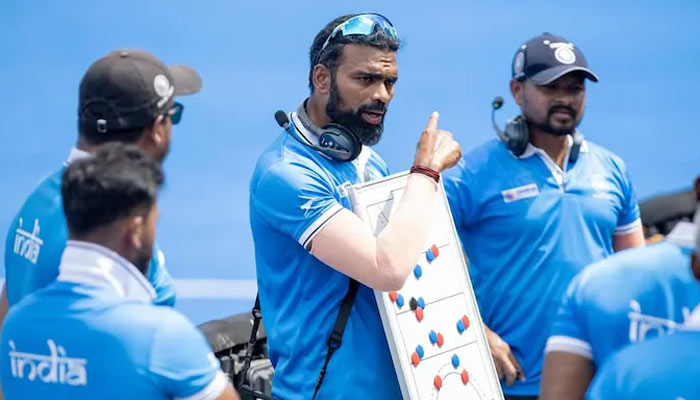
When P. R. Sreejesh arrived at the Hockey India Awards in March, something felt different.
The usually cheerful and media-friendly former goalkeeper kept to himself through the evening, avoiding conversations and declining interview requests. At the time, it appeared unusual. In hindsight, it now feels like the silence before a storm.
That storm finally erupted on May 13.
In a strongly worded social media post, Sreejesh revealed that he was no longer the head coach of India’s junior men’s hockey team, a role he had taken up immediately after helping India secure a historic bronze medal at the Paris Olympics. The decision triggered widespread debate across Indian hockey, especially after Sreejesh claimed he had been pushed aside despite guiding the junior side to multiple podium finishes.
Hockey India quickly responded, insisting that Sreejesh had not been removed but had instead been offered a new role with the development squad as part of long-term planning for the Los Angeles 2028 Olympics. The federation also defended its decision to appoint experienced foreign coach Frederic Soyez to the junior setup, arguing that the team required greater technical expertise at that level.
But the explanation only intensified scrutiny around Hockey India’s decision-making.
If Sreejesh lacked coaching experience, critics asked, why was he appointed in the first place? And if Hockey India genuinely wanted to nurture Indian coaches, why move on from one of the country’s most respected hockey figures after just 18 months?
Those questions resonated deeply with former India captain Jude Felix, who believes the federation has once again mishandled a coach’s development.
Speaking about the controversy, Felix said he was initially surprised when Sreejesh was appointed as junior coach because elite playing credentials do not automatically guarantee coaching success. However, he stressed that once Hockey India had made that choice, the federation needed to fully support and clearly define expectations for him.
Felix argued that Sreejesh’s results were not insignificant. Under his tenure, the junior team secured medals and remained competitive internationally. If Hockey India expected gold medals immediately, Felix suggested, then the federation should have made those targets explicit from the outset.
The former captain also said he personally related to Sreejesh’s frustration because he had experienced something similar himself. Felix, who coached India’s junior side in the past, accused Hockey India of repeatedly discarding coaches without giving them sufficient time to grow into their roles.
According to Felix, the larger problem lies in the federation’s constant search for foreign solutions. He questioned whether India’s long line of overseas coaches had truly delivered transformative results despite receiving extensive resources and freedom within the system.
Felix pointed to India’s strong performance at the 1994 Hockey World Cup, where he captained the side under Indian coach Cedric D’Souza, as proof that homegrown leadership can succeed at the highest level. He argued that Indian coaches are often removed too quickly, preventing continuity and long-term development.
He also highlighted the case of coach Shanmugham Pandurangan, whom he described as one of the country’s brightest coaching minds but another casualty of frequent restructuring within Indian hockey.
For Felix, the biggest issue was not simply Sreejesh losing his role. It was the speed with which the federation appeared to lose faith in a coach they had only recently projected as part of Indian hockey’s future.
He insisted that coaches require time to understand players, establish systems, and evolve tactically. Removing someone after only a year and a half, according to Felix, reflects flawed planning rather than failed coaching.
In his view, Hockey India’s handling of the situation ultimately insulted Sreejesh because it suggested the federation either misjudged his capabilities from the beginning or abandoned the project before it had a genuine chance to succeed.
For Indian hockey, the episode has once again reopened uncomfortable questions about coaching stability, long-term planning, and the federation’s continued dependence on foreign expertise. For Sreejesh, meanwhile, the controversy marks an abrupt and deeply personal interruption to what many believed was only the beginning of his coaching journey.
Comments are closed.