

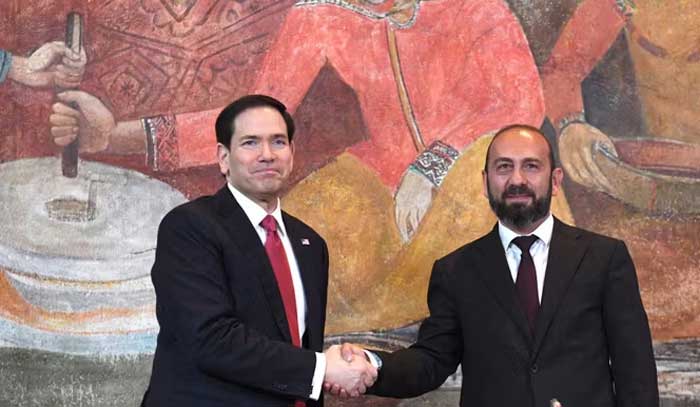
The United States on Tuesday said it would move forward with Armenia on a planned transport corridor linking parts of Azerbaijan, as Secretary of State Marco Rubio made a brief stop in the South Caucasus during his return trip from India.
Rubio met Armenian Foreign Minister Ararat Mirzoyan during a refueling stop in Yerevan, a rare high-level US visit to the country, which has historically been aligned with Russia but has increasingly sought closer ties with the West.
At the centre of the discussions was a proposed road-and-rail project known as the Trump Route for International Peace and Prosperity (TRIPP), an initiative backed by US President Donald Trump’s administration. The corridor would pass through Armenian territory and connect mainland Azerbaijan with its Nakhchivan exclave, which is separated from the rest of the country by Armenia.
Rubio and Mirzoyan initialled a further step in the TRIPP process, which the US State Department said lays out the framework for a joint venture, including preparations for an engineering survey. The latest document has not been made public.
“This agreement marks the biggest step to date on making this historic route a reality, on advancing peace, and on increasing prosperity in Armenia and frankly in the region,” Rubio said at a signing ceremony at Yerevan airport.
According to US officials, earlier discussions in January outlined a broader structure in which Armenia would hold sovereignty over the corridor while a US-linked development company would take a 74 percent stake in its management, with an emphasis on facilitating US commercial participation.
The push comes as Armenia continues to recalibrate its foreign policy. Long dependent on Russia for security, Yerevan has grown increasingly distant from Moscow following Azerbaijan’s 2023 military offensive that brought the disputed Karabakh region back under Azerbaijani control.
Since then, Prime Minister Nikol Pashinyan’s government has frozen participation in the Russian-led Collective Security Treaty Organisation (CSTO) and signalled interest in deeper integration with the European Union, drawing criticism from the Kremlin.
At the same time, Armenia has maintained a delicate balancing act in relations with Iran, which borders the country to the south and has expressed concern over any foreign-controlled infrastructure corridor in the region. Armenian officials have sought to reassure Tehran that sovereignty over the route would remain with Armenia.
Rubio also signed agreements in Yerevan aimed at strengthening a broader US–Armenia strategic partnership, including cooperation on critical minerals — a sector Washington is seeking to secure amid China’s global dominance of supply chains essential for advanced technologies.
“We are laying the groundwork for the sort of economic engagement that allows Armenians to make money and find prosperity and Americans to do the same and to do it together,” Rubio said, adding that the cooperation would “respect your sovereignty as a nation.”
Armenian Foreign Minister Ararat Mirzoyan welcomed the agreements, saying they were “truly beneficial for the Republic of Armenia” and expressing hope they would soon translate into practical outcomes.
High-level US visits to Armenia have been relatively uncommon, although Vice President JD Vance visited both Armenia and Azerbaijan earlier this year as part of a broader regional peace effort. That trip drew attention after controversy over a now-deleted social media post referencing the World War I-era mass killings of Armenians in the Ottoman Empire.
The Armenian genocide remains a sensitive diplomatic issue. Former US president Joe Biden formally recognised the killings as genocide, while Donald Trump has avoided using the term — a position strongly opposed by Turkey.
Comments are closed.