
US Deploys Warships, Marines Near Cuba Amid Rising Tensions and Donald Trump Warning Signals

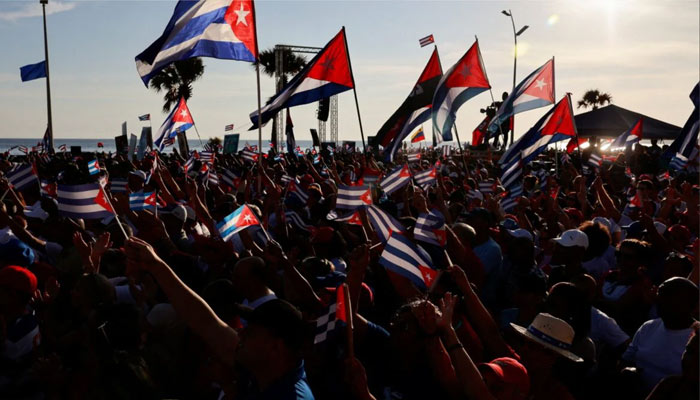
The United States has reportedly spent months positioning warships, Marines and surveillance assets near Cuba, creating what analysts describe as a significant military presence.
In the region as President Donald Trump continues signalling the possibility of direct action against Havana. According to a report by Politico, the Pentagon has quietly assembled a range of military capabilities that could allow Washington to launch operations against Cuba at short notice if tensions escalate further.
The reported build-up includes the USS Nimitz aircraft carrier strike group, guided missile destroyers and cruisers capable of carrying out precision strikes, along with surveillance drones and reconnaissance aircraft monitoring Cuban territory.
The report also stated that the USS Kearsarge amphibious readiness group, carrying nearly 2,500 Marines, is preparing for possible deployment and could replace vessels already stationed near the region.
Military analysts quoted in the report suggested that the deployment gives Washington multiple operational options ranging from pressure tactics and targeted air strikes to a broader military operation focused on key Cuban military and leadership infrastructure.
Former Pentagon official Mark Cancian reportedly described the deployment of the USS Nimitz as “primarily for intimidation,” though he acknowledged the carrier group could support combat operations if required.
Cancian reportedly said potential military scenarios could involve strikes aimed at disabling Cuban air defence systems and other strategic targets.
The report further highlighted comments made by US Secretary of State Marco Rubio during a Cabinet meeting, where he reportedly described Cuba as being “in a lot of trouble” and argued that “having a failed state 90 miles from our shores is a threat to the national security of the United States.”
At the same time, the growing military posture has reportedly raised concerns within the Pentagon itself.
According to Politico, several US naval vessels involved in the deployment have already spent close to 10 months at sea — significantly longer than the standard operational rotation period. Defence officials are reportedly worried that unusually long deployments could affect crew morale, maintenance cycles and overall naval readiness.
Meanwhile, Cuba has appealed to the international community to intervene diplomatically and prevent what Havana describes as the risk of a humanitarian crisis triggered by US pressure and military threats.
According to AFP, Cuban Foreign Minister Bruno Rodríguez Parrilla urged the United Nations Security Council to act urgently against what he called the combined effects of economic blockade measures and escalating military pressure from Washington.
“I call on the international community to mobilise to prevent a humanitarian catastrophe,” Rodriguez reportedly told the Security Council, while urging countries to show solidarity with Cuba.
The Cuban government has accused Washington of attempting to manufacture conditions for regime change amid worsening economic conditions on the island, including shortages of food, medicine and fuel, as well as repeated nationwide power outages.
The tensions have intensified after the Trump administration accused former Cuban president Raúl Castro in connection with the 1996 downing of two US-based aircraft — a move Havana strongly condemned.
Rodriguez dismissed US claims that Cuba poses a national security threat, saying such arguments “go against logic and common sense.”
Trump himself has repeatedly fuelled speculation about possible military action.
According to AP, the US President recently told reporters at the White House that earlier administrations had considered acting against Cuba for decades but stopped short of doing so.
“Other presidents have looked at this for 50 or 60 years,” Trump reportedly said. “It looks like I’ll be the one who does it.”
Rubio has also argued that Cuba’s growing ties with countries such as China and Russia pose a strategic concern for the United States.
Although the administration has publicly stated it prefers a negotiated outcome, reports suggest senior US officials — including Rubio and CIA Director John Ratcliffe — held discussions with Cuban representatives in recent months, though those efforts reportedly produced little progress.
Rubio reportedly said the Cuban leadership was attempting to “buy time and wait us out,” while insisting the Trump administration remained “very serious” and “very focused” on the issue.
Comments are closed.