
Supreme Court of India questions National Testing Agency on anti-leak measures in NEET case

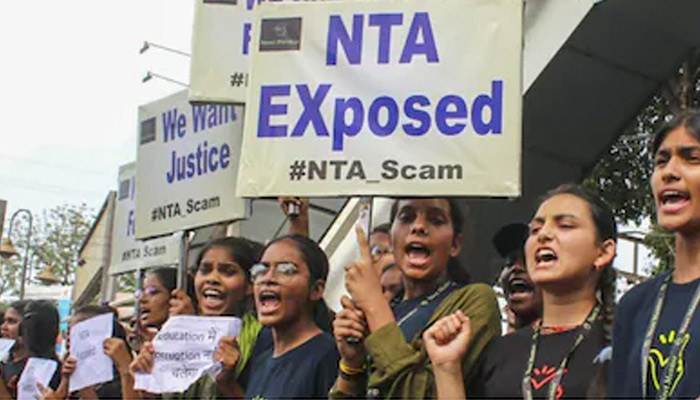
The Supreme Court of India on Friday sharply questioned the functioning of the National Testing Agency over the NEET-UG 2026 paper leak controversy, warning.
That repeated irregularities were undermining public confidence in national-level examinations. Hearing a batch of petitions seeking reforms in the conduct of NEET-UG, a bench led by Justice PS Narasimha said the NTA should take lessons from institutions such as the Union Public Service Commission, which have maintained credibility in conducting large-scale competitive examinations.
“UPSC has never been in such a situation. You need to learn,” Justice Narasimha observed during the proceedings.
The court said the issue extended beyond a single examination and raised larger concerns about institutional accountability, continuity, and the integrity of systems governing competitive tests taken by lakhs of students every year.
The bench questioned how such a serious lapse could occur despite the existence of a high-powered committee formed to prevent examination irregularities.
“Despite a high-powered committee, if this incident happened, there is something wrong with the original recommendation, or there is no proper implementation,” the court remarked.
The petitions, filed by the Federation of All India Medical Association (FAIMA) and the United Doctors Front (UDF), have sought structural reforms within the NTA after allegations of paper leaks and malpractice in NEET-UG 2026.
Appearing for the Centre and the NTA, Solicitor General Tushar Mehta told the court that the government was taking the issue seriously and that multiple corrective measures had already been introduced.
“We are dealing with youth, and the government is very serious about the problems of the youth,” Mehta said.
He added that the re-NEET process and the implementation of additional safeguards were being supervised “at the highest level of the executive.” According to Mehta, several new mechanisms had been introduced for future examinations, though details were not being disclosed publicly for security reasons.
“Some new mechanisms are put in place for the examinations. It may not be appropriate to divulge what’s there. Otherwise, it may defeat the purpose,” he submitted.
During the hearing, Mehta also informed the court that Prime Minister Narendra Modi was personally monitoring the matter.
Justice Narasimha, however, stressed that the court’s concerns were not limited to temporary solutions and instead focused on deeper institutional weaknesses within the NTA.
“The problem with most of our institutions is ad hocism. The knowledge doesn’t percolate. It is not the individual who has the capability. It is the institution,” the judge observed.
The bench further emphasised the need for clear accountability in agencies conducting sensitive national examinations.
“The real problem is accountability. Unless we identify the responsibility, you won’t really know. It is the most sensitive thing,” Justice Narasimha said.
Retired Justice R Radhakrishnan, who heads the steering committee examining reforms, informed the court that both short-term and long-term recommendations had been prepared, with several already implemented.
He said loopholes related to transportation of question papers and examination management had been addressed and assured the court that additional safeguards would be in place for the upcoming re-NEET examination.
In its affidavit, the NTA informed the court that it had introduced several structural and security reforms after the controversy. These included mandatory CCTV checks, preservation of footage for at least 90 days, mock drills at centres, weather contingency planning, verification of backup power systems, and post-examination forensic analysis of CCTV recordings.
The agency also said 16 new senior-level positions had been created as part of its restructuring process. Experts from institutions including IITs, CBSE, UGC, KVS and IGNOU had also been brought in to strengthen examination management and security.
The Supreme Court directed the Union government to file a fresh affidavit explaining how future examinations would be conducted and how continuity and institutional memory within the NTA would be maintained.
Dictating its order, the bench said the affidavit should explain “the method in which an institutional memory through continuity of human resources, institutional plurality by composition of experts, etc, is put in place.”
“It is very traumatic if this is happening. We cannot disappoint our students. It is not merely the student, it’s the family too. It is so much of emotions, love, time, years of study,” Justice Narasimha observed.
Comments are closed.