

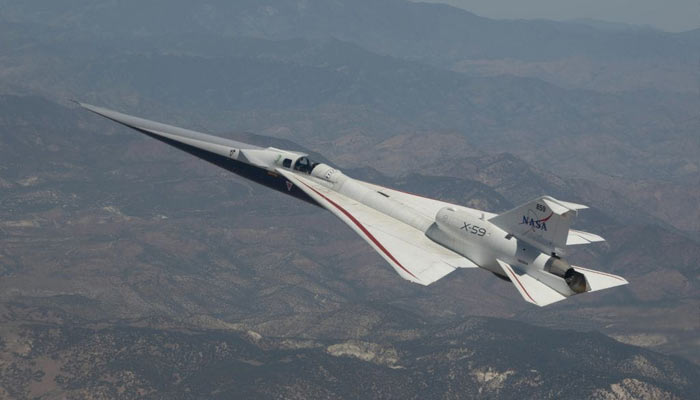
NASA’s X-59 Edges Closer to Flight, Bringing Quiet Supersonic Travel a Step Nearer
For decades, the dream of commercial supersonic air travel has been held back by one major problem: the sonic boom.
Now, NASA believes it may have found a solution.
The US space agency’s experimental X-59 aircraft has successfully completed another round of critical ground testing, moving a step closer to its highly anticipated first flight. Developed in partnership with aerospace giant Lockheed Martin, the aircraft is at the heart of NASA’s Quiet SuperSonic Technology (Quesst) mission, which aims to prove that aircraft can fly faster than the speed of sound without producing the thunderous boom that has long restricted supersonic travel over land.
The latest tests validated key systems and operational performance, giving engineers greater confidence as they prepare the aircraft for take-off.
- The Aircraft Designed to Silence the Sonic Boom
- What makes the X-59 unlike any aircraft currently flying is its striking design.
Stretching nearly 30 metres in length, the aircraft features an exceptionally long and narrow nose that accounts for roughly one-third of its overall size. This unusual shape is not just for appearance — it is central to the aircraft’s mission.
Traditional supersonic aircraft generate powerful shock waves as they break the sound barrier. When those shock waves reach the ground, they are heard as a loud sonic boom that can rattle buildings and disturb communities below.
NASA’s engineers have designed the X-59 to reshape and distribute those shock waves before they reach the ground. Instead of a disruptive boom, people below are expected to hear only a much softer sound, often compared to a distant car door closing or a muted thump.
If the technology performs as expected, it could remove one of the biggest obstacles facing the return of commercial supersonic aviation.
What Happened During the Latest Tests?
The recent testing campaign focused on ensuring the aircraft is ready for flight operations.
Engineers examined the X-59’s avionics, flight-control systems and integrated software, while also assessing how various components function together under simulated flight conditions. Ground-based evaluations and taxi tests were carried out to verify that the aircraft can safely transition from testing on the runway to actual flight.
According to NASA, the successful completion of these assessments represents a major milestone in the programme’s development.
How Fast Will the X-59 Fly?
The aircraft is designed to cruise at approximately Mach 1.4 — around 1,500 kilometres per hour — at an altitude of roughly 55,000 feet.
At those speeds, passengers could eventually travel between major cities significantly faster than on today’s commercial aircraft.
For comparison, conventional long-haul airliners typically cruise at speeds of around 850 to 900 kilometres per hour.
Why NASA’s Experiment Matters
The X-59 is not being developed as a commercial passenger aircraft. Instead, it is a flying laboratory designed to gather data that could shape the future of aviation.
Once flight testing begins, NASA plans to fly the aircraft over selected communities across the United States. Residents will be asked to share their experiences and perceptions of the aircraft’s reduced noise signature.
The data collected will then be provided to regulators, including aviation authorities responsible for setting noise standards and flight restrictions.
If regulators determine that the aircraft’s noise levels are acceptable, decades-old restrictions on overland supersonic flight could eventually be revisited.
Could Supersonic Passenger Flights Return?
The last major era of supersonic passenger travel ended in 2003 with the retirement of the Concorde, the Anglo-French aircraft that could cross the Atlantic in less than four hours.
Since then, several aerospace companies have pursued next-generation supersonic concepts, but challenges related to noise, fuel efficiency and environmental concerns have slowed progress.
NASA’s X-59 is focused on addressing one of those key hurdles — the sonic boom. Success would not guarantee the return of commercial supersonic travel, but it could remove a significant regulatory barrier and open the door to a new generation of faster aircraft.
With ground testing continuing to deliver positive results, the X-59 is now closer than ever to demonstrating whether quiet supersonic flight can move from engineering ambition to everyday reality.
Comments are closed.