
Novak Djokovic Equals Roger Federer’s Open Era Grand Slam Milestone at Roland Garros

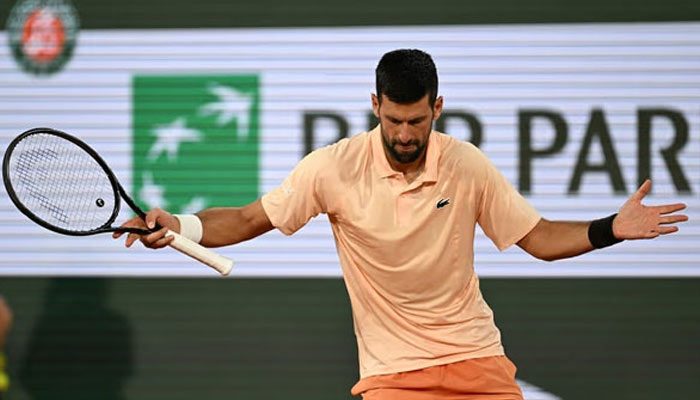
Third seed Novak Djokovic moved one step closer to a record-extending 25th Grand Slam title.
After battling past France’s Valentin Royer 6-3, 6-2, 6-7(7-9), 6-3 to reach the third round at Roland-Garros on Wednesday, May 27.
The victory marked another milestone for the Serbian star, as Djokovic reached the third round at Roland-Garros for the 21st consecutive year, equalling Roger Federer’s Open Era record for most consecutive third-round appearances at a single Grand Slam tournament.
Playing under the Paris sunshine on Court Philippe-Chatrier, Djokovic initially looked set for a comfortable straight-sets victory. The 38-year-old dominated the opening two sets with clinical serving and sharp baseline control against world No. 74 Royer.
However, the Frenchman produced an inspired response in the third set, feeding off strong home support. Royer pushed the set into a tense tiebreak, where he saved a match point before edging Djokovic 9-7 to extend the contest and ignite the crowd inside Philippe-Chatrier.
The unexpected resistance briefly disrupted Djokovic’s rhythm as Royer continued to fight through pressure moments and forced the Serbian into longer rallies. But the 24-time Grand Slam champion regained composure in the fourth set, tightening his service games and finding his trademark precision at crucial moments.
Djokovic eventually closed out the match after earning another match point with a timely ace, ending a spirited challenge from the French wildcard and booking his place in the next round.
Elsewhere at Roland-Garros, fans witnessed another dramatic battle as 26th seed Jakub Mensik survived a gruelling five-set marathon against Argentina’s Mariano Navone. The Czech youngster overcame severe cramps to secure a 6-3, 2-6, 6-4, 1-6, 7-6(13-11) victory after converting his seventh match point in a match lasting four hours and 41 minutes in scorching 33°C conditions.
Mensik collapsed onto the clay after sealing the win, underlining the brutal physical demands of Grand Slam tennis, where endurance and mental resilience often prove just as important as shot-making brilliance.
Comments are closed.